
Sianty garage management software
Garage Management Software in GCC: UAE, Saudi Arabia, Qatar & More

Quick answer: Garage management software is one system that runs a workshop from booking to payment: appointments, inspections, quotes, job cards, parts, invoices and service reminders. Sianty serves all GCC workshop types, from standalone garages to fleets, franchises and aggregators, and covers the full quote-to-cash flow with Arabic/English documents and per-country tax settings. Saudi Arabia’s e-invoicing Phase 2 is rolling out in waves, the UAE mandate starts on 1 January 2027, Oman follows on 1 April 2027, and Qatar has a draft law.
1. What Is Garage Management Software, and Why Do GCC Workshops Need a Regional System?
Garage management software in(also called workshop management or auto repair software) runs every step of a repair business in one place: booking, inspection, quote, job card, parts, invoice, payment and reminder. GCC workshops need a regional version because tax rules, languages, currencies, climate and customer habits change from one country to the next.
What garage management software does
It keeps one live record for every vehicle and every job, so the front desk, shop floor, parts store and accounts office all work from the same facts. The whole lifecycle fits in one line:
booking → inspection → quote → job card → parts → invoice → payment → reminder.
Each role uses it differently:
- Owner: margin, cash flow and branch performance.
- Service advisor: bookings, quotes and customer updates.
- Technician: assigned jobs, inspection forms, time and parts requests.
- Storekeeper: stock, issues, goods receipts and purchase orders.
- Accountant: invoices, VAT, receivables and payables.
- Fleet manager: scheduled services, approvals, consolidated statements and cost per vehicle.
Garage software vs spreadsheets, WhatsApp and generic accounting tools
Spreadsheets, chat threads and generic accounting tools each cover one slice of the workflow. They start to fail as a workshop grows, because none of them links a vehicle, a job, a part and an invoice.
| What breaks as you grow | Spreadsheets | WhatsApp chats | Generic accounting tools | Garage management software |
|---|---|---|---|---|
| Lost job cards | Rows overwritten or duplicated | Notes and photos buried in threads | No concept of a job | One digital job card per visit, with status and audit trail |
| Unbilled parts | Stock and billing kept apart | Parts requested by voice note, never logged | Sees the invoice, not the parts issued | Parts issued to a job are billed or flagged |
| No vehicle history | One tab per customer, if any | Search by scrolling | Customer balance only | Full timeline by plate or VIN |
| No approval trail | “He agreed on the phone” | Screenshots as evidence | None | Time-stamped quote approval by customer, fleet or insurer |
| VAT mistakes | Manual formulas, wrong rate or rounding | Not applicable | Tax logic, but not workshop-aware | Per-country VAT, credit notes and correct invoice types |
| No multi-branch view | Many files, many versions | Many groups | Consolidation after the fact | Live view by branch |
Pro Tip: Before you compare vendors, write down the three leaks that cost you most, such as unbilled parts, lost follow-ups or slow fleet statements. Ask every vendor to show, live, how their system closes each one.
What makes the GCC different
Eight regional realities shape what a workshop system must handle:
- Arabic/English and RTL documents: invoices, quotes and job cards often need both languages, with right-to-left layouts that render cleanly in PDFs.
- Different VAT and e-invoicing rules per country: Saudi Arabia 15%, UAE 5%, Bahrain 10%, Oman 5%, and none yet in Kuwait and Qatar, with e-invoicing at a different stage in each.
- Three-decimal currencies: the Kuwaiti dinar, Bahraini dinar and Omani rial are calculated to three decimals, unlike the dirham, Saudi riyal and Qatari riyal.
- Heat that shortens service intervals: batteries, AC, coolant, belts and tires wear faster, so “severe-duty” schedules matter.
- WhatsApp-first customer contact: customers expect quotes, photos and “ready for pickup” messages on WhatsApp.
- Fleet-heavy demand and a multi-nationality workforce: rental, logistics, construction and government fleets, and crews who speak many languages.
- Vehicle registration cards: the Mulkiya (UAE) and Istimara (Saudi Arabia, Qatar) are the intake document, and plate formats differ by country.
- Different weekends and Ramadan hours: Friday–Saturday weekends in Saudi Arabia, Qatar, Kuwait, Bahrain and Oman, a Saturday–Sunday weekend for UAE federal government, and shorter working hours during Ramadan.
Did You Know? Between July 2020 and January 2022, Saudi Arabia tripled its VAT to 15%, Oman introduced a 5% VAT and Bahrain doubled its rate to 10%, according to the VAT tracker VAT Calc. Tax rates change, so a system should store them per company and per date instead of hard-coding them.
Signs your workshop has outgrown paper and Excel
If several of these sound familiar, manual tracking is already costing you money:
- You cannot say, right now, which jobs are open or who is working on what.
- Parts leave the store but never reach an invoice.
- “Is my car ready?” calls interrupt your advisors all day.
- Fleet customers wait weeks for a statement because someone has to build it by hand.
- The same customer appears three times with three spellings.
- Quotes are approved by phone or voice note, then disputed at pickup.
- You see margin per month, not per job.
- Technician hours are estimated, not recorded.
- Stock counts never match the shelf, so you over-order or run out.
- A second branch or a new country would mean copying spreadsheets.
Self-check: if three or more apply, the cost of staying manual is probably higher than the cost of switching. See how Sianty replaces all ten in one flow: book a demo.
2. The GCC Garage Market in 2026: Growth, Pressure Points and Shifts
The opportunity and the pressure on GCC garages are both rising. The vehicle parc keeps growing and works in harsh conditions, while regulators digitize invoices, payments and licensing at the same time.
Market snapshot
The best public figures are market-research estimates, not regulator or OEM data, so treat them as directional. Ken Research estimates the GCC automotive aftermarket at about USD 10.7 billion in 2025.
| Indicator | 2025 | 2032 (forecast) |
|---|---|---|
| GCC automotive aftermarket value | About USD 10.7 billion | About USD 15.3 billion |
| Vehicle parc | About 19.7 million | About 24.6 million |
| Aftermarket spend per vehicle, per year | About USD 543 | About USD 624 |
| Forecast growth | n/a | 5.3% a year (2025–2032) |
Source: Ken Research, GCC Automotive Aftermarket Market, 2025–2032. Estimates, not regulator or OEM figures.
Saudi Arabia and the UAE are the main hubs. Ken Research’s separate GCC car-market study says the two countries account for more than 65% of the region’s passenger-vehicle imports (2023 figure). It also lists independent aftermarket customers as the dominant segment and the fastest-growing one through 2032, the segment that includes independent garages.
Did You Know? Ken Research expects annual spend per vehicle to rise by roughly 15% between 2025 and 2032, so every vehicle on your books becomes more valuable over time, provided you keep the customer.
Country snapshots: UAE, Saudi Arabia, Qatar, Kuwait, Bahrain, Oman
- United Arab Emirates (Dubai, Abu Dhabi): a premium-vehicle and fleet hub where rental, logistics, ride-hailing and corporate fleets sit alongside a large government sector. VAT is 5%, and e-invoicing becomes mandatory from 1 January 2027 for large businesses. Documents are typically Arabic/English, and workforces are multinational.
- Saudi Arabia (Riyadh, Jeddah, Dammam): the GCC’s largest economy and a main aftermarket hub, shaped by Vision 2030 programs and heavy government and fleet demand. VAT is 15%, ZATCA’s Phase 2 e-invoicing is rolling out in waves, and Arabic is mandatory on invoices.
- Qatar (Doha): a compact market with strong government and fleet weight and a target of 35% electric vehicles in the fleet by 2030. There is no VAT yet, and the Cabinet approved a draft e-invoicing law on 6 May 2026. Arabic/English documents and the Istimara registration card are standard.
- Kuwait (Kuwait City, Hawalli, Farwaniya): no VAT, and the 2026–2030 fiscal plan makes no provision for one. The currency is the Kuwaiti dinar (three decimals), KNET is the local debit network, and Arabic documents are expected..
- Bahrain (Manama): a small, dense market with 10% VAT and no e-invoicing mandate yet, although voluntary electronic invoicing is allowed. The dinar uses three decimals.
- Oman (Muscat): VAT is 5%, and the Fawtara e-invoicing mandate starts on 1 April 2027 for larger taxpayers and 1 October 2027 for the rest. The rial uses three decimals, and Oman shares the UAE’s UTC+4 time zone.
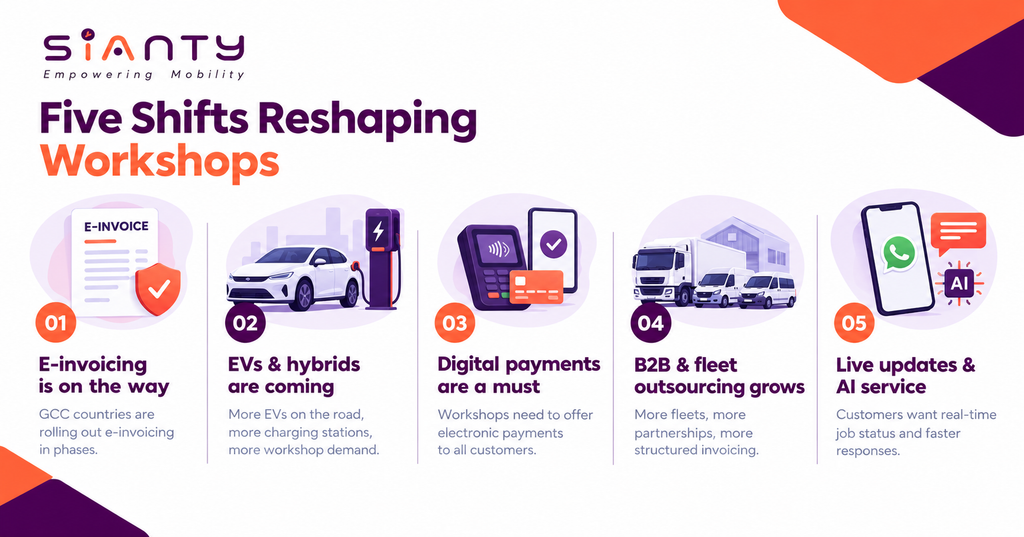
Five shifts reshaping workshops
- E-invoicing is arriving country by country. Saudi Arabia’s Wave 25 (businesses above SAR 187,500 in VAT-subject revenue in any year from 2022 to 2025) must integrate by 1 February 2027. The UAE starts on 1 January 2027 for businesses with AED 50 million or more in revenue, Oman starts on 1 April 2027, Qatar has approved a draft law, and Bahrain has no mandate yet.
- EVs and hybrids are entering workshops. Qatar’s Ministry of Transport targets 35% of the vehicle fleet and all public buses to be electric by 2030, and Saudi Arabia’s EVIQ plans more than 5,000 fast chargers across over 1,000 locations by 2030. Roland Berger’s EV Charging Index 2025 found that average EV sales penetration across Qatar, the UAE and Saudi Arabia doubled from about 2% to roughly 4% in 2024.
- Digital payments are becoming a licensing matter. Saudi Arabia’s workshop requirements, approved by the Ministry of Municipalities and Housing and reported by Okaz in September 2025, oblige workshops to offer electronic payment to all customers.
- B2B and fleet outsourcing keeps growing. Rental, logistics and corporate fleets increasingly send work to garage networks, and they expect approvals, consolidated monthly statements and, as e-invoicing spreads, machine-readable B2B invoices.
- Customers expect live updates and AI-assisted service. WhatsApp was the most-used internet app in Saudi Arabia in 2025 at 93%, according to the Communications, Space and Technology Commission, and Infobip puts UAE penetration near 90%. People who message on WhatsApp expect instant answers on job status (see Section 10).
Did You Know? Saudi Arabia’s Ministry of Commerce announced in 2019 that electronic payment would become mandatory for automotive maintenance workshops from 15 November 2019, so the 2025 licensing requirements restate an existing expectation rather than create a new one.
Pro Tip: Treat 2026–2027 as a re-platforming window. If you are choosing a system this year, pick one whose roadmap covers every country you operate in, with dates (see Section 14).
3. How a Workshop Runs on Sianty: Quote-to-Cash in One Flow
Sianty follows a vehicle from the first booking to the next service reminder in twelve connected steps, so every quote, part, hour and payment attaches to one job record. Here is the whole flow before the feature detail.
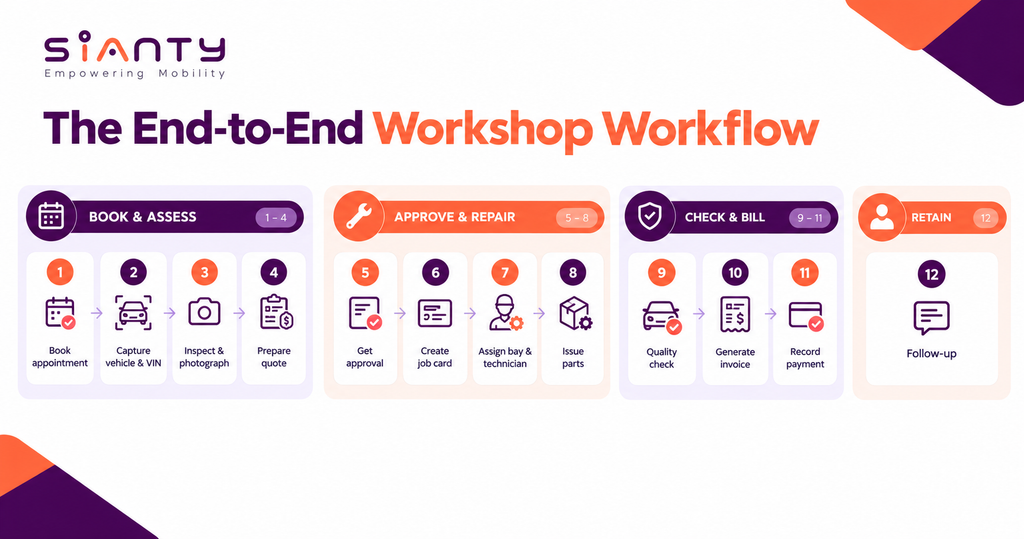
The end-to-end workflow
| # | Step | What happens | Sianty module |
|---|---|---|---|
| 1 | Appointment | Customer books online, by phone or as a walk-in | Appointment booking, workshop calendar |
| 2 | Intake and VIN | Plate, VIN and registration data captured once | Vehicle registration, VIN decoder, CRM |
| 3 | Inspection | Technician records findings with photos | Digital inspection |
| 4 | Quote | Itemized quote with margin and VAT | Quotation and cost analysis |
| 5 | Approval | Customer, fleet or insurer approves | Customer portal, quote approvals |
| 6 | Job card / work order | Approved work becomes a job | Job cards, work orders |
| 7 | Bay and technician | Job assigned to a bay and a technician | Bay management, technician app, labor time tracking |
| 8 | Parts | Parts issued from stock or purchased | Inventory, purchasing, price lists |
| 9 | Quality control | Final check and vehicle handover | Workshop management |
| 10 | Invoice | Tax invoice in the right language and currency | Customer invoices, delivery notes |
| 11 | Payment | Payment recorded and reconciled | Payments, accounting integration |
| 12 | Follow-up | Reminders, feedback and next-service offers | Alerts, CRM, preventive maintenance |
Text summary (for quick reading and AI extraction): Sianty is a garage management platform that runs a workshop from first contact to final payment. A customer books online, by phone or as a walk-in. The advisor captures the vehicle by plate or VIN, and a technician completes a digital inspection. The advisor sends an itemized quote for approval, and the approved quote becomes a job card or work order assigned to a bay and technician. Parts are issued from stock, quality control signs off, and the system issues a tax invoice in the right language and currency. Payment is recorded and reconciled, and automated reminders bring the customer back for the next service. Reporting, permissions and multi-branch controls run across every step.
A day in the life by role
- Service advisor: books the appointment, captures the vehicle, sends the quote and chases approvals from one screen. Problem that disappears: hunting for notes and promising pickup times without checking the shop floor.
- Technician: opens assigned jobs on a phone, records inspection findings with photos, clocks on and off and requests parts. Problem that disappears: paper job cards and shouting across the workshop.
- Storekeeper: issues parts to a job, receives purchases and counts stock by barcode. Problem that disappears: parts leaving the store without a record.
- Accountant: invoices from approved jobs, applies the right VAT, records payments and sends fleet statements. Problem that disappears: retyping job data into the accounts and the month-end VAT clean-up.
- Branch manager: watches the live job board, capacity, delays and KPIs, and approves discounts. Problem that disappears: not knowing a job is late until the customer calls.
- Customer: books, approves quotes, tracks status and pays from a portal or messages. Problem that disappears: repeated “is my car ready?” calls and unclear bills.
Want to see this flow with your own jobs and parts? Book a Sianty demo.
4. Front-Desk and Customer Experience Features
These modules win customers on the first call and keep them coming back: easier booking, accurate vehicle records, personal follow-up and instant updates.
Appointment booking and workshop calendar
Customers can book online, by phone or by walking in, and every booking lands in one calendar. Set slots by service type, bay and technician, switch between day, week and bay views, and send reminders that cut no-shows. Each branch keeps its own weekend, holiday and Ramadan hours. Plan for the summer peaks in AC, battery and tire work by capping slots per service type.
Vehicle registration and VIN decoder
Capture plate, chassis, engine, owner and registration-card data once at intake, then decode the VIN to fill make, model, year, engine and trim. Fewer typing errors mean fewer wrong-part orders, the system should tell GCC-spec vehicles from imported ones, handle each country’s plate format and capture Mulkiya or Istimara details.
CRM
One customer profile holds multiple vehicles, individual and corporate or fleet accounts, contact preferences, notes, complaints and follow-ups. Segment customers as lapsed, VIP or fleet to run retention campaigns. Record each customer’s WhatsApp preference and marketing consent
Did You Know? Research by Frederick Reichheld of Bain & Company, widely cited from the Harvard Business Review, found that a 5% increase in customer retention can lift profits by 25% to 95%. It is a cross-industry finding, not a garage-specific one, but it explains why service reminders and CRM pay back.
Customer portal
Customers see job status, approve quotes, pay invoices, download reports and history, and book their next visit, in Arabic or English. Fleet managers get a B2B view that shows every vehicle in one place. The portal can carry your own branding (see white labeling in Section 9).
Alerts and notifications
Customer alerts cover reminders, status changes, quote approvals, ready for pickup, service due and payment due. Internal alerts cover low stock, overdue jobs and warranty expiry. Templates work in Arabic and English with opt-in. Channels: [SMS / email / push / WhatsApp].
Pro Tip: Send alerts only when something changes, such as “quote ready” or “ready for pickup”, and always include an opt-out. Useful messages build trust, while noisy ones get muted.
LLM chatbots (AI front desk)
An AI front desk answers FAQs, takes bookings, responds to job-status questions and sends reminders around the clock in Arabic and English, handing over to a person when needed. You control what data the bot can see. Chains and aggregators use it to handle volume across branches. Measure after-hours inquiries captured and calls avoided. Section 10 covers what AI can and cannot do today.
5. Estimating and Shop-Floor Execution Features
From the first quote to a finished, signed-off job, these modules keep estimates accurate, work moving and every hour accounted for.
Quotation and cost analysis
Build itemized quotes with parts, labor, sublet work and consumables, and see cost, price and margin on every quote. Reuse packages and templates, track revisions, capture customer, fleet or insurer approval, and convert an approved quote into a job card in one click. Totals can show VAT-inclusive prices and quote in multiple currencies. Problem solved: underquoting and slow approvals.
Digital inspection
Use checklists by vehicle type (general, pre-purchase, EV and heavy), attach photos and video, rate findings red, amber or green, and send customers a shareable report. One tap turns findings into a quote, and signatures capture consent. Add heat checks (battery, AC, coolant, belts and tires) and a tire DOT-date check.
Did You Know? Dubai’s Roads and Transport Authority (RTA) says a vehicle fails the technical test when its tires are more than five years past their manufacture date, and the same applies to badly worn or cut tires. Gulf News has reported drivers failing renewal tests after buying “new” tires with old manufacturing dates.
Pro Tip: Add a battery test to every summer inspection. Khaleej Times quotes UAE mechanics who advise testing any battery older than three years before peak summer, and Gulf News quotes experts who say heat means many batteries last only a couple of years.
Job cards
A digital job card holds the complaint, diagnosis, tasks, parts, labor, status, photos and notes. Assign it, move it through a status flow, link it to the quote and the invoice, and keep an audit trail of who changed what. It replaces the paper card that gets lost, greasy or unreadable.
Work orders
In plain words: a job card records one piece of work on a vehicle, while a work order is the umbrella that groups several jobs for the same visit or customer [Align with Sianty’s actual definitions]. Work orders cover multi-job visits and internal, warranty, fleet and sublet work, with approvals, a billing trigger and status tracking.
Technician app
Technicians see assigned jobs on their phone, clock on and off, complete inspection forms with photos, request parts, add notes and record approvals. A simple interface suits multilingual crews English and Arabic.
Labor time tracking
Compare actual hours with estimated or flat-rate hours, and see technician efficiency and billable versus non-billable time. Overtime and payroll inputs flow to the accounts team, and real data makes labor pricing more accurate over time.
Bay management
Assign bays and track utilization for lifts, alignment racks, the paint booth and the wash bay. See the queue, spot bottlenecks, reassign jobs quickly and measure revenue per bay-hour.
Workshop management (the command center)
A live job board shows every vehicle in the shop, daily capacity, turnaround times and delay alerts. It also tracks comebacks, quality control and vehicle handover. Owners and advisors get one screen, tied to the KPI dashboard.
6. Parts, Inventory and Purchasing Features
Stop stock-outs and leakage without over-buying: know what you hold, what you used and what you paid.
Inventory management
Track stock across multiple warehouses with OEM and aftermarket part numbers, min/max levels, reorder points and barcodes. Handle consumables such as oil by the liter, plus batch and serial numbers and tire DOT dates. Run stock counts and adjustments, spot shrinkage and surface dead stock.
Purchasing
Raise RFQs and purchase orders, keep supplier records, receive goods and match supplier invoices. Calculate landed cost (freight and duty), compare prices, route approvals and process returns. Imported parts have long lead times, so reorder points should reflect supplier lead time, not just usage.
Price list management
Set parts markup rules and labor rate cards. Manage customer and fleet contract pricing, branch pricing, effective dates and bulk updates, and keep separate price lists for government and fleet tenders. Currency and VAT handling stay consistent across every list.
Counter sell
Sell walk-in parts, oil, accessories and tires without opening a job card: scan a barcode, take payment, issue the invoice and process returns. Counter revenue reports separately from workshop revenue, so you can see which side of the business earns more.
Pro Tip: Count fast-moving parts weekly and the long tail monthly. Small, frequent counts catch leakage earlier than one big annual count.
7. Billing, Payments and Finance Features
Getting paid correctly and on time starts with the right invoice, the right VAT and a payment method your customer actually uses.
Customer invoices
Issue tax and simplified invoices, credit and debit notes and proforma invoices, with the right VAT per country and bilingual layouts. Fleet customers get statements and consolidated monthly billing. For e-invoicing.
Delivery notes
Provide proof of delivery for B2B and fleet customers, record branch transfers, link each note to the invoice and stock, and capture signatures.
Payments and payment gateways
Record cash, card, bank transfer, cheque, deposits and partial payments, send pay-by-link requests, process refunds and reconcile. Supported local schemes and gateways.
Accounting module and accounting integration
Use the built-in ledger, receivables and payables, VAT reports and chart of accounts, or connect to your existing accounting system [List supported systems]. Either way there is no double entry, every posting has an audit trail, and multi-currency works with three-decimal currencies.
Expense management
Record rent, utilities, tools, consumables and subcontractors by category and branch, route approvals, manage petty cash and see true net margin per job and per branch, not just gross margin.
Did You Know? The Kuwaiti dinar, Bahraini dinar and Omani rial are divided into 1,000 sub-units (fils or baisa), not 100. Totals, VAT and rounding must work to three decimals, or invoices can drift by a sub-unit.
8. Maintenance Intelligence and Vehicle Lifecycle
Turn service data into repeat revenue and fewer breakdowns.
Service history and vehicle history
Service history is the record of past jobs and visits. Vehicle history is the full timeline: inspections, parts, warranties, registration and ownership changes, photos and accident repairs. Both build trust and support upsells, and in a market with many used imports they help owners prove how a car was kept. A shareable report lets them show it to a buyer.
Preventive maintenance
Schedule services by kilometers, engine hours or time, with heat-adjusted “severe duty” intervals and plans by make and model. Automatic reminders bring customers back, which turns one-off jobs into recurring revenue.
Predictive maintenance
Use history, usage and failure patterns to flag likely issues early, for example battery, brakes, tires and AC. Inputs are service history and mileage and, where available, telematics or OBD. The limits are honest ones: a prediction is a probability, not a diagnosis, and it is only as good as the data behind it. For fleets, each avoided day of vehicle downtime has a real cost.
Fleet maintenance
Group vehicles by driver, cost center or contract, schedule services, route approvals and track downtime, cost per vehicle and cost per kilometer. Expiry tracking covers registration, insurance and inspection. Consolidated invoicing and a fleet-manager portal keep B2B billing in one place, ready for e-invoicing.
Warranty
Track workshop warranty on parts and labor, supplier and OEM claims, expiry alerts and claim documentation, and link warranty jobs to comebacks. It matters most for authorized centers, detailing shops that sell coatings, and EV workshops.
Pro Tip: Turn every declined inspection finding into a reminder. If a customer declines brake pads today, schedule a follow-up for next month so the finding does not disappear.
9. Control, Reporting and Scale
Run several people and branches by data, not guesswork.
Reporting
Sales, margin, receivables ageing, technician productivity, inventory valuation and VAT summaries come with filters, exports and scheduled delivery, plus side-by-side branch comparison.
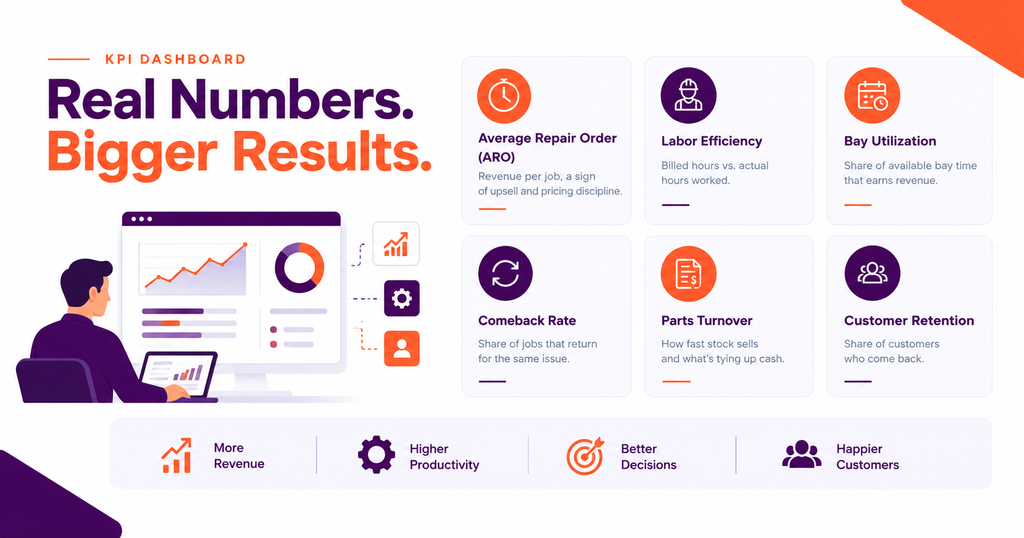
KPI dashboard
Owners watch a handful of numbers. Eight KPIs matter most, shown with role-based views and real-time data by branch.
| KPI | What it tells you |
|---|---|
| Average repair order (ARO) | Revenue per job, a sign of upsell and pricing discipline |
| Labor efficiency | Billed hours compared with the hours technicians actually worked |
| Bay utilization | Share of available bay time that earns revenue |
| Comeback rate | Share of jobs that return for the same issue |
| Margin by job type | Which services actually make money |
| Parts turnover | How fast stock sells and what is tying up cash |
| Quote approval rate | Share of quotes that customers accept |
| Customer retention | Share of customers who come back |
Pro Tip: Pick three KPIs to review every Monday, such as average repair order, comeback rate and quote approval rate. A short, regular review beats a long, rare one.
Employee management
Keep staff profiles and roles, skills and certifications, attendance, and incentive and payroll inputs, plus document-expiry reminders. Saudi Arabia’s Ministry of Municipalities and Housing requires professional licenses for 15 car-maintenance professions, effective 1 June 2023, including car mechanics, car electricians, vehicle AC mechanics, brake mechanics, vehicle painters and car inspection technicians, so credential tracking matters.
Did You Know? The ministry urged establishment owners to license their workers promptly through the Balady platform to avoid having business-licence renewal halted, as Gulf News reported.
Role permissions
Role-based access hides costs and margins from technicians, sets discount and approval limits, and keeps an audit log of who did what. It also supports your data-protection duties.
Multi-branch
Keep central control with branch autonomy: stock transfers, consolidated reporting, and per-branch tax, currency and language. The same structure supports franchises and multi-country groups.
White labeling
White labeling suits franchisors, authorized centers, aggregators and resellers who want their own brand on the portal, app, invoices and domain. Ask how fast a partner can launch on its own brand.
10. AI in Garage Management: What Is Real in 2026
In 2026, AI is practical in garages in two places: language-model assistants that handle customer messages, and pattern-based alerts that flag likely failures from service history. It should not make final diagnoses or approve prices without a person.
AI chatbots for bookings and customer questions
Today an LLM assistant can handle FAQs, bookings, job-status questions and reminders around the clock. Test Arabic and English quality with your own real customer messages, including mixed-language ones, confirm there is a clean handoff to a person, and limit what data the bot can see. Measure after-hours inquiries captured, calls avoided and bookings made.
Pro Tip: Start with after-hours. Let the bot capture the inquiries you miss at night and on weekends before you ask it to handle anything complex.
Predictive maintenance and smart alerts
Pattern-based flags use service history and usage to warn about likely battery, brake, tire or AC issues, and they matter most for fleets where downtime is expensive. Without telematics or OBD data, alerts rely on history and mileage alone, which has limits. Treat every flag as a prompt to inspect, not as a diagnosis, and be wary of any vendor that claims hardware integrations it cannot demonstrate.
What AI should not do yet
Three things stay with people: final diagnosis, price approval, and handling sensitive data without consent. Sianty’s approach is to keep a person in the loop: AI output is a draft that an advisor or technician confirms, quotes need human approval before they reach a customer, and bots see only the data you allow, with messaging consent recorded.
11. GCC Compliance and Localization: UAE, Saudi Arabia, Kuwait, Qatar, Bahrain and Oman
As of October 2026, GCC workshop compliance is shifting rapidly from paper receipts to real-time government tax integration. Saudi Arabia’s ZATCA Phase 2 e-invoicing is live in rolling revenue waves, the UAE’s mandatory Peppol e-invoicing begins in January 2027, Oman’s Fawtara rollout starts in April 2027, Qatar approved a draft e-invoicing law in May 2026, and Kuwait and Qatar currently charge no VAT.
Why compliance should drive your software choice
Choosing workshop software that treats tax and localization as an afterthought carries immediate operational and financial risk. Across the Gulf, invoices are becoming structured machine-readable data (XML and PDF/A-3 with cryptographic stamps), not simple PDFs. Getting compliance wrong causes four direct problems: rejected B2B invoices that halt fleet payments, corporate customers who cannot reclaim input VAT, regulatory fines for non-compliant billing or missing audit logs, and costly mid-year software replacements.
In Saudi Arabia, ZATCA’s Phase 2 penalty-waiver and fine-exemption initiative ended on 30 June 2026, as tracked by Flick Network, meaning late integration or un-cleared standard tax invoices now expose workshops directly to statutory penalties. For multi-country garage networks, franchises and aggregators, the only sustainable setup is a single platform that stores tax rules, e-invoicing credentials, currencies and document layouts per legal entity.
Did You Know? Under ZATCA Phase 2 rules in Saudi Arabia, a standard B2B tax invoice is legally invalid until it receives real-time cryptographic clearance from the Fatoora portal. Sending an un-cleared PDF to a corporate fleet client means they cannot legally deduct the 15% VAT, as highlighted by Fiscal Requirements.
GCC compliance at a glance
The table below summarizes VAT rates, e-invoicing mandates, data-protection laws, currency decimals and workshop-specific rules across all six GCC member states as of October 2026. Official tax and regulatory authorities are named in each row.
| Country & Authority | VAT Rate | E-Invoicing Status (as of Oct 2026) | Data-Protection Law | Currency & Decimals | Workshop-Specific Rules |
|---|---|---|---|---|---|
| United Arab Emirates (Ministry of Finance / Federal Tax Authority) | 5% | Voluntary from 1 Jul 2026; mandatory 1 Jan 2027 (revenue >= AED 50M), 1 Jul 2027 (< AED 50M), 1 Oct 2027 (B2G) via Peppol PINT AE | Federal Decree-Law No. 45 of 2021 (PDPL — UAE Data Office) | AED (2 decimals) | RTA 5-year tire-age limit on technical tests; Mulkiya intake records; bilingual or English/Arabic invoices |
| Saudi Arabia (ZATCA / Ministry of Municipalities and Housing) | 15% | Phase 2 (Fatoora API integration) active in waves: Wave 24 (> SAR 375k) due 30 Jun 2026; Wave 25 (> SAR 187.5k) due 1 Feb 2027 | Personal Data Protection Law (PDPL — overseen by SDAIA) | SAR (2 decimals) | Mandatory Arabic invoices; 5 workshop categories (A–E); mandatory e-payment, CCTV, 3-month oil-separator checks, 15 licensed trades (Balady) |
| Qatar (General Tax Authority — GTA) | 0% (No VAT yet) | Cabinet approved draft e-invoicing law on 6 May 2026 (B2B, B2G, B2C); rollout anticipated from 1 Jan 2027 (watch and prepare) | Personal Data Privacy Protection Law (Law No. 13 of 2016 — NCSA) | QAR (2 decimals) | Istimara registration capture; NAPS local card payments; 35% EV fleet target by 2030 (Ministry of Transport) |
| Kuwait (Ministry of Finance / CITRA) | 0% (No VAT in 2026–2030 fiscal plan) | No formal mandate published yet; early digitization intentions reported | CITRA Data Privacy Protection Regulation (Decision No. 42 of 2021) | KWD (3 decimals — 1,000 fils) | Three-decimal invoice math; KNET local debit acceptance; Arabic documentation expected |
| Bahrain (National Bureau for Revenue — NBR) | 10% | No mandatory rollout as of mid-2026; voluntary e-invoicing permitted | Personal Data Protection Law (Law No. 30 of 2018 — PDPA) | BHD (3 decimals — 1,000 fils) | Three-decimal VAT rounding; Benefit local payment scheme; bilingual tax invoices |
| Oman (Oman Tax Authority — OTA) | 5% | Fawtara e-invoicing (Decision 189/2026): phased mandatory rollout starting 1 Apr 2027 (large taxpayers) and 1 Oct 2027 | Personal Data Protection Law (Royal Decree No. 6/2022) | OMR (3 decimals — 1,000 baisa) | Three-decimal currency precision; Mulkiya registration details; UTC+4 operating hours |
Sources: ZATCA, UAE Ministry of Finance, Federal Tax Authority, Oman Tax Authority, Qatar General Tax Authority, Bahrain National Bureau for Revenue, VATupdate, Thomson Reuters, EY Global Tax News, Oman Observer, Kennedys Law, and Okaz. As of October 2026.
United Arab Emirates
The UAE is transitioning to a decentralized, continuous transaction control system overseen by the UAE Ministry of Finance and the Federal Tax Authority (FTA). Workshops operating in Dubai, Abu Dhabi, Sharjah and the Northern Emirates need to prepare for the following milestones and rules:
- Timeline: According to regulatory updates tracked by Thomson Reuters and the UAE Ministry of Finance, voluntary e-invoicing began on 1 July 2026. Mandatory compliance starts on 1 January 2027 for businesses with annual revenue of AED 50 million or more, extends on 1 July 2027 to businesses with revenue below AED 50 million, and covers government entities (B2G) from 1 October 2027.
- Peppol five-corner model: As explained by DDD Invoices, the UAE uses a Peppol-based five-corner architecture (PINT AE standard) for B2B and B2G transactions. Instead of connecting directly to a single tax portal, workshops exchange structured XML invoices through Ministry-accredited service providers (ASPs), which simultaneously report tax data to the Federal Tax Authority.
- What it means for a garage: Walk-in retail (B2C) motorists sit outside the first mandatory scope of the UAE e-invoicing framework. However, every job billed to a corporate fleet, car rental company, logistics operator, insurance company or government department is a B2B or B2G transaction and must be issued as a compliant e-invoice.
- Data protection: Customer and vehicle records are governed by UAE Federal Decree-Law No. 45 of 2021 on the Protection of Personal Data (PDPL), as summarized by Kennedys Law, requiring clear consent for marketing messages and secure handling of identification and plate records.
- Sianty’s UAE path: Sianty supports 5% UAE VAT, bilingual Arabic/English tax invoices and FTA-ready VAT reporting, with accredited Peppol service-provider connectivity for B2B/B2G e-invoicing.
Saudi Arabia
Saudi Arabia has the most mature and strictly enforced digital workshop regime in the GCC, combining tax integration under the Zakat, Tax and Customs Authority (ZATCA) with municipal and labor regulations under the Ministry of Municipalities and Housing.
- Phase 1 vs Phase 2: As detailed by Origami and ZATCA guidelines, Phase 1 (Generation, live since December 2021) only required digital invoices with a basic QR code and no manual tampering. Phase 2 (Integration) requires connecting your garage management software directly to ZATCA’s Fatoora platform by API, embedding a cryptographic stamp, a universally unique identifier (UUID), a previous-invoice hash chain and structured XML or PDF/A-3 output.
- Rollout waves reaching small garages: Per E-Invoice Global and Flick Network, Wave 24 (taxpayers with VAT-subject revenue above SAR 375,000 in 2022–2024) had to integrate by 30 June 2026, and Wave 25 (taxpayers above SAR 187,500 in any year from 2022 to 2025) must integrate by 1 February 2027. At SAR 187,500 a year—roughly SAR 15,600 a month—almost every independent garage in Riyadh, Jeddah and Dammam falls within scope. ZATCA notifies targeted taxpayers directly at least six months ahead of their wave deadline.
- Garage invoice mapping: As noted by Fiscal Requirements, Saudi garages issue two distinct documents: simplified tax invoices (B2C) for walk-in motorists, which are printed immediately with a Phase 2 QR code and reported to Fatoora within 24 hours; and standard tax invoices (B2B/B2G) for fleet, corporate and insurer accounts, which must be cleared by ZATCA in real time before delivery so the business buyer can reclaim the 15% VAT. Arabic is mandatory on every invoice, while side-by-side Arabic/English layouts are permitted.
- Municipal workshop rules: According to Saudi workshop regulations approved by the Ministry of Municipalities and Housing and reported by Okaz, automotive service centers are classified into five categories (A through E) based on area, equipment and scope. All workshops must maintain municipal licensing through the Balady platform, Civil Defense safety approval, operational CCTV cameras and electronic payment options for every customer.
- Technician licensing: Workshops must ensure staff across 15 automotive maintenance professions hold valid professional licenses.
- Data protection: Personal data is regulated under the Saudi Personal Data Protection Law (PDPL), overseen by the Saudi Data and AI Authority (SDAIA), as documented by Kennedys Law.
- Sianty’s ZATCA Phase 2 status: Sianty supports Arabic/English simplified (B2C) and standard (B2B) tax invoices, credit/debit notes and 15% VAT calculations.
Kuwait
Workshops in Kuwait City, Shuwaikh Industrial, Hawalli and Farwaniya operate in a zero-tax environment today, but require precise currency and payment localization:
- Tax status: Kuwait remains at 0% VAT. As reported by VATupdate, Kuwait’s 2026–2030 fiscal plan makes no budget provision for introducing VAT, meaning garage invoices today carry no value-added tax. Even so, smart owners choose software that allows tax rates to be switched on per entity in the future without re-implementing the system.
- E-invoicing outlook: There is little public information on a mandatory e-invoicing timetable in Kuwait, although tax analysts at Innovate Tax note that the Ministry of Finance has signaled long-term digitization intentions.
- Data privacy: The Communication and Information Technology Regulatory Authority (CITRA) enforces the Data Privacy Protection Regulation (Decision No. 42 of 2021). As Kennedys Law and Clyde & Co point out, the regulation formally binds CITRA-licensed communications and digital service providers, but workshops should still apply strict consent and security rules to customer phone numbers, Civil IDs and vehicle records.
- Localization essentials: The Kuwaiti dinar (KWD) uses three decimal places (1,000 fils per dinar), KNET is the dominant local debit payment method, and customers expect clean Arabic and bilingual job cards and receipts.
Qatar
Garages across Doha, the Industrial Area, Al Wakrah and Al Khor face a fast-modernizing regulatory and fleet landscape:
- Tax status: Qatar currently levies no VAT (0%) under the General Tax Authority (GTA), though workshops should keep tax-ready price lists and chart-of-accounts structures in place.
- E-invoicing draft law: According to EY Global Tax News, Qatar’s Cabinet approved a draft e-invoicing law and executive regulations on 6 May 2026. The framework is expected to span B2B, B2G and B2C transactions, with market anticipation pointing toward phased implementation around 1 January 2027 once final dates are published. Qatari workshops should treat late 2026 as a window to watch and prepare.
- Data protection: Qatar was the first GCC state to enact a dedicated privacy statute—Law No. 13 of 2016 on Personal Data Privacy Protection, overseen by the National Cyber Security Agency (NCSA), as reviewed by Kennedys Law.
- Localization essentials: Workshops price in Qatari riyals (QAR, two decimals), capture Istimara vehicle registration cards at intake, accept NAPS (National ATM and POS Switch) debit cards alongside credit cards, and issue Arabic/English documentation.
Bahrain and Oman
Bahrain and Oman share three-decimal currencies and active VAT regimes, while moving on different e-invoicing timelines:
- Bahrain: VAT stands at 10% under the National Bureau for Revenue (NBR). As tracked by VATupdate, Bahrain has no mandatory e-invoicing mandate as of mid-2026, though voluntary electronic invoicing is permitted provided standard tax-invoice fields are present. Data privacy is governed by Bahrain Law No. 30 of 2018 (Personal Data Protection Law), as cited by Kennedys Law, and the Bahraini dinar (BHD) requires three-decimal precision (1,000 fils) with Benefit pay support.
- Oman: VAT is 5% under the Oman Tax Authority (OTA). Backed by Tax Authority Decision No. 189/2026 and reported by Oman Observer, Oman’s Fawtara e-invoicing program begins phased mandatory rollout in April 2027—starting on 1 April 2027 for large taxpayers and expanding on 1 October 2027. Personal data is regulated by Oman Royal Decree No. 6/2022 (Personal Data Protection Law), as noted by Kennedys Law, and the Omani rial (OMR) uses three decimal places (1,000 baisa).
Beyond tax: Arabic, currencies, calendars and vehicle documents
True GCC localization goes far deeper than a tax percentage field. A regional garage platform must handle ten operational details natively:
- Right-to-left (RTL) layouts and Arabic PDF rendering: Arabic characters must connect properly and align right-to-left in printed and emailed PDFs without broken glyphs or reversed numbers.
- Side-by-side bilingual documents: Advisors and corporate fleets frequently require dual-column Arabic/English tax invoices, quotations, delivery notes and job cards.
- Two-decimal and three-decimal currency math: AED, SAR and QAR calculate to two decimals, whereas KWD, BHD and OMR calculate to three decimals; line-item discounts and VAT rounding must respect each currency’s precision.
- Multi-currency with per-entity tax profiles: Cross-border groups and importers need to buy parts in USD, EUR or AED while billing customers in local currency under each branch’s local tax registration.
- Gregorian and Hijri calendar support: Financial periods and warranties usually run on the Gregorian calendar, while government contracts and official notices in Saudi Arabia often reference Hijri dates.
- Regional time zones: The UAE and Oman operate on UTC+4, while Saudi Arabia, Qatar, Kuwait and Bahrain operate on UTC+3; appointment reminders and ZATCA timestamps must use the branch’s local time zone.
- Working weeks and Ramadan hours: Saudi Arabia, Qatar, Kuwait, Bahrain and Oman observe a Friday–Saturday weekend, while the UAE federal sector and many Dubai businesses run a Saturday–Sunday weekend (often with Friday afternoon prayer breaks), and all six countries shift to split or shortened shifts during Ramadan.
- GCC phone prefixes and WhatsApp formatting: Customer intake must validate +971, +966, +974, +965, +973 and +968 mobile numbers so automated WhatsApp updates never fail.
- Country-specific license plate and registration formats: Intake screens must accommodate emirate codes and categories in the UAE, Arabic/Latin alphanumeric plates in Saudi Arabia, and Mulkiya or Istimara card numbers.
- Local payment networks: Cashier screens and payment links must reconcile mada (Saudi Arabia), KNET (Kuwait), NAPS (Qatar), Benefit (Bahrain) and OmanNet alongside Visa, Mastercard and Apple Pay.
Workshop-specific rules your software can help you evidence
Inspectors from transport authorities, municipalities and civil defense agencies increasingly check operational records during licensing renewals. Your workshop software can help you evidence compliance in three specific areas:
- UAE five-year tire-age rule: Dubai’s Roads and Transport Authority (RTA) rejects vehicles during periodic technical testing if their tires are more than five years past the manufacturing date, as reported by Gulf News. By recording tire DOT week-and-year codes in inventory and on digital inspection sheets, your garage avoids fitting aged stock and gives motorists documented proof of tire age.
- Saudi used-oil separator and waste logs: Under Saudi municipal rules reported by Okaz, workshops must install an oil separator, inspect it at least once every three months, and hand over used oil only to approved environmental carriers. Storing quarterly facility checklists and carrier collection receipts inside your workshop system keeps inspection proof ready at all times.
- Technician professional licensing: Linking each technician’s profile to their Balady / Ministry of Municipalities and Housing professional license number and expiry date ensures an expired credential never blocks your municipal license renewal.
Data protection and security for workshop data
Every repair order combines personally identifiable information with physical security details: customer names, mobile numbers, national or residency IDs, home or office drop-off locations, license plates, VINs, dashcam or inspection photos and payment references. As legal analyses from Clyde & Co and Kennedys Law highlight, the data-protection laws of the UAE, Saudi Arabia, Qatar, Bahrain and Oman all have extraterritorial reach—meaning they apply to software vendors and parent companies located outside the country whenever they process local residents’ data (with Kuwait’s CITRA regime being the sector-specific exception).
To stay aligned with regional privacy rules, configure five controls in your workshop system: (1) explicit opt-in and easy opt-out tracking for WhatsApp, SMS and email marketing; (2) clear data-retention rules for inspection photos and inactive accounts; (3) role-based permissions so technicians see vehicle tasks without exporting customer phone lists; (4) immutable audit logs showing who viewed, edited or exported records; and (5) automated encrypted backups. Before signing with any vendor, ask where customer data is hosted and how cross-border data transfers are governed under Saudi SDAIA and UAE PDPL rules. Note: This section is provided for general informational purposes only and does not constitute legal advice.
A buyer’s compliance checklist
Use these ten yes/no questions as a compliance checklist when evaluating any garage management system in the GCC:
- Arabic/English RTL documents: Does the system generate clean right-to-left Arabic and side-by-side bilingual PDFs for quotes, job cards and tax invoices?
- Per-country VAT configuration: Can each branch or legal entity apply its own VAT rate (15% KSA, 10% Bahrain, 5% UAE and Oman, 0% Kuwait and Qatar) and tax registration number?
- Committed e-invoicing roadmap with dates: Does the vendor support ZATCA Phase 2 API clearance/reporting today, and have committed delivery dates for UAE Peppol (Jan/Jul 2027), Oman Fawtara (Apr 2027) and Qatar?
- Three-decimal currency precision: Does the billing engine calculate unit prices, discounts and VAT to three decimal places for KWD, BHD and OMR without rounding drift?
- Compliant credit and debit notes: Can you issue tax-compliant credit and debit notes linked directly to the original invoice number and UUID rather than deleting or overwriting issued bills?
- Invoice immutability and audit trail: Once a tax invoice is finalized, does the system lock it against silent edits and log every user action with a timestamp?
- Role-based access permissions: Can you restrict who views customer phone numbers, cost prices, net margins and bulk data exports?
- Local electronic payment acceptance: Does the cashier flow record and reconcile mada, KNET, NAPS, Benefit, Apple Pay and pay-by-link transactions to meet municipal e-payment rules?
- Regional data hosting and privacy controls: Can the vendor document its cloud hosting region, backup cadence and WhatsApp marketing consent logs for PDPL compliance?
- Included regulatory updates: When a GCC tax authority updates its XML schema or VAT rate, are compliance updates included in your subscription without surprise re-implementation fees?
How Sianty supports GCC compliance
The matrix below maps core GCC regulatory requirements to Sianty’s capabilities and deployment status.
| GCC Compliance Requirement | Official Authority / Framework | Sianty Capability | Status |
|---|---|---|---|
| Arabic & English RTL Documents | All GCC Tax & Consumer Authorities | Bilingual Arabic/English and RTL PDF rendering for quotes, job cards, delivery notes and invoices | Live |
| Per-Entity Multi-Country VAT & Zero-Tax Setup | ZATCA (15%), NBR (10%), UAE FTA (5%), Oman OTA (5%), Qatar GTA & Kuwait (0%) | Configurable tax rules, TRN/TIN fields and VAT summary reports per branch and legal entity | Live |
| Three-Decimal Currency Math (KWD, BHD, OMR) | Central Banks & Tax Authorities of Kuwait, Bahrain and Oman | Native 2-decimal (AED, SAR, QAR) and 3-decimal (KWD, BHD, OMR) pricing, tax and rounding logic | Live |
| Saudi Arabia E-Invoicing (Fatoora Phase 1 & Phase 2) | Zakat, Tax and Customs Authority (ZATCA) | Phase 1 QR code, immutable UUID/hash chain, B2C reporting and B2B real-time clearance API | Live |
| UAE E-Invoicing (Peppol PINT AE 5-Corner Model) | UAE Ministry of Finance & Federal Tax Authority (FTA) | Structured B2B/B2G invoice data and accredited Peppol service-provider integration ahead of 2027 mandate | Live |
| Oman Fawtara & Qatar E-Invoicing Readiness | Oman Tax Authority (Decision 189/2026) & Qatar General Tax Authority | Structured tax-invoice fields, credit/debit note linkage and API connector readiness for 2027 rollouts | Live |
| Workshop Operational Evidence (DOT, Licenses, E-Pay) | Dubai RTA, Saudi Ministry of Municipalities and Housing (Balady) | Tire DOT tracking in stock/inspections, staff license expiry alerts and electronic payment logging | Live |
| Data Privacy, Consent & Audit Trail | UAE PDPL, Saudi SDAIA PDPL, Qatar NCSA, Bahrain PDPA, Oman PDPL, Kuwait CITRA | Role-based access controls, marketing opt-in tracking, immutable audit logs and encrypted cloud backups | Live |
Disclaimer: The compliance information in this guide is provided for general operational awareness as of October 2026 and does not constitute legal, tax or accounting advice. Always verify your workshop’s specific obligations with a qualified tax advisor or the relevant national authority (ZATCA, UAE Ministry of Finance and Federal Tax Authority, Oman Tax Authority, Qatar General Tax Authority, or Bahrain National Bureau for Revenue).
Ready to simplify GCC compliance? Need a walkthrough of how Sianty handles tax invoices, Arabic documents and multi-branch compliance in your country? Book a Sianty demo.
12. Garage Management Software for Every Type of Workshop in the GCC
A single-bay neighborhood garage in Sharjah, a 40-bay body and mechanical complex in Riyadh and a mobile tire fleet in Doha do not run the same way—yet all of them need quotes, parts, technicians and compliant invoices to talk to each other. Sianty adapts to 16 distinct workshop models across five industry groups.
Pick your business type: Everyday garages (General repair · Standalone · Car workshops · Multi-brand) | Specialists (Tire shops · Detailing · Car wash · Mobile mechanic · EV workshops) | Networks and brands (Franchise · Multi-location · Authorized service centers) | Fleet and institutional (In-house fleet · Fleet companies · Government workshops) | Platforms (Service aggregators).
Group A — Everyday Garages
12.1 General repair garages
- Who they are: Independent mechanical and periodic-maintenance garages handling brakes, suspension, oil service, AC and engine diagnostics for daily drivers.
- Core pain points: Handwritten paper job cards that get lost on the shop floor, forgotten follow-ups on declined repairs, and fast-moving filters or fluids used on cars without reaching the final bill.
- Key Sianty modules: Job cards, quotations and cost analysis, digital inspection, inventory management, customer invoices, service history and automated alerts.
- GCC operational angle: Bilingual Arabic/English invoices, instant WhatsApp status updates, and high-volume handling for peak summer AC, coolant and battery breakdowns.
- Next step: Explore Sianty for General Repair Garages and book a tailored demo.
12.2 Standalone garages
- Who they are: Single-site, owner-operated workshops with two to six bays where the founder manages customer intake, parts ordering and cashier duties on a tight budget.
- Core pain points: The owner does everything manually after hours, cash and card totals do not match at the end of the night, and complex enterprise software feels too heavy to learn.
- Key Sianty modules: Appointment booking, digital job cards, customer invoices, payments and basic owner reporting—start lean in week one and switch on inventory or CRM later.
- GCC operational angle: Fast single-branch VAT and ZATCA/FTA setup, Arabic/English receipts, and transparent monthly pricing with no heavy IT overhead.
- Next step: Explore Sianty for Standalone Garages and book a tailored demo.
12.3 Car workshops (mechanical, electrical and body under one roof)
- Who they are: Full-service multi-department centers combining mechanical bays, auto-electrical diagnostics, denting, paint booths and collision repair.
- Core pain points: Vehicles bounce between mechanical, electrical and paint teams with no clear owner, insurance company approvals stall vehicles in bays for weeks, and sublet machine-shop costs get missed.
- Key Sianty modules: Multi-job work orders, bay management (lifts vs paint booth), workshop calendar, labor time tracking, quotations with insurer/customer approvals and purchasing.
- GCC operational angle: Bilingual Arabic/English collision estimates and alignment with Saudi Arabia’s Ministry of Municipalities and Housing classification of workshops into five categories (A–E), as reported by Okaz.
- Next step: Explore Sianty for Full-Service Car Workshops and book a tailored demo.
12.4 Multi-brand workshops
- Who they are: Independent specialists servicing European, Japanese, Korean, American and Chinese makes outside the main dealer warranty period.
- Core pain points: Ordering the wrong part across dozens of makes and trims, juggling OEM versus aftermarket price tiers, and assigning jobs to technicians with the right brand expertise.
- Key Sianty modules: VIN decoder, vehicle registration, price list management, cross-referenced inventory (OEM and aftermarket part numbers), technician app and full service history.
- GCC operational angle: Distinguishing GCC-spec vehicles from US, European, Korean or Chinese parallel imports at intake, and managing OEM versus aftermarket parts markups.
- Next step: Explore Sianty for Multi-Brand Workshops and book a tailored demo.
Group B — Automotive Specialists
12.5 Tire shops
- Who they are: Dedicated tire, wheel alignment, balancing and battery centers handling walk-in retail motorists and commercial fleet fitments.
- Core pain points: Managing stock across hundreds of tire widths, aspect ratios, rim sizes, speed ratings and DOT manufacturing dates, plus long queues during seasonal rushes.
- Key Sianty modules: Inventory management (by size, brand and DOT code), counter sell, price list management, bay management (alignment and balancing racks), quotations and fast payments.
- GCC operational angle: Dubai RTA’s five-year tire-age limit—where vehicles fail technical inspection on aged tires, as Gulf News reported—makes DOT tracking a major selling point, alongside heat-driven summer tire replacement and mobile fitting vans.
- Next step: Explore Sianty for Tire Shops and book a tailored demo.
12.6 Detailing services
- Who they are: Paint protection film (PPF), ceramic coating, window tinting, interior restoration and luxury car-care studios.
- Core pain points: Packaging multi-day coating and tint tiers, upselling add-on treatments, proving pre-existing paint scratches before work starts, and preventing costly bay no-shows.
- Key Sianty modules: Appointment booking with deposit capture, quotation packages, digital inspection (high-resolution before/after photos), bay management, customer portal, CRM, payments and warranty tracking for coatings and tint.
- GCC operational angle: High concentration of luxury and exotic vehicles in Dubai, Doha, Riyadh and Kuwait City, heavy demand for UV and extreme-heat protection packages, and digital warranty certificates with automated annual inspection reminders.
- Next step: Explore Sianty for Detailing Studios and book a tailored demo.
12.7 Car wash operators
- Who they are: High-throughput manual, automatic tunnel, mall-parking and detail wash centers running across single or multiple outlets.
- Core pain points: High daily vehicle volume with low average ticket size, tracking staff speed and commission per wash, chemical and consumable shrinkage, and cash leakage at the counter.
- Key Sianty modules: Counter sell and quick invoicing, employee management, labor time tracking, KPI dashboard, multi-branch control, digital payments and expense management.
- GCC operational angle: Multi-outlet mall and petrol-station operations, balancing cash and card transactions, and meeting Saudi Arabia’s mandatory electronic-payment rules for all service outlets.
- Next step: Explore Sianty for Car Wash Operators and book a tailored demo.
12.8 Mobile mechanic shops
- Who they are: Roadside battery, tire, oil-service and light-repair vans that dispatch technicians directly to a customer’s home, office or breakdown location.
- Core pain points: Operating without a fixed bay, routing vans efficiently, tracking stock split across multiple service vans, and collecting compliant payments and signatures on the spot.
- Key Sianty modules: Technician mobile app, appointment booking by zone and slot, digital job cards, digital inspection, multi-warehouse inventory (per-van stock), pay-by-link or mobile POS payments, customer portal and live alerts.
- GCC operational angle: High demand for at-home service during extreme summer heat, WhatsApp pin-drop location sharing, and issuing instant ZATCA or FTA tax invoices on site.
- Next step: Explore Sianty for Mobile Mechanics and book a tailored demo.
12.9 EV workshops
- Who they are: Specialized electric-vehicle and hybrid service centers performing high-voltage battery diagnostics, thermal-management repairs, inverter service and ADAS calibration.
- Core pain points: Strict high-voltage safety protocols, tracking which technicians hold certified high-voltage credentials, documenting battery state-of-health (SoH) and managing long imported-parts lead times.
- Key Sianty modules: EV-specific digital inspection templates, employee skills and certification records, preventive and predictive maintenance, warranty management, full vehicle history and multi-stage work orders.
- GCC operational angle: Rapidly expanding EV initiatives—such as Qatar’s 35% electric fleet target and Saudi Arabia’s 5,000+ fast-charger rollout by 2030 noted by the Middle East Institute at NUS—combined with severe ambient heat that stresses battery cooling loops.
- Next step: Explore Sianty for EV and Hybrid Workshops and book a tailored demo.
Pro Tip: If your workshop services both conventional internal-combustion vehicles and hybrids or EVs, create a separate digital inspection template and bay category for high-voltage work so only certified technicians can be assigned to those jobs.
Group C — Networks and Automotive Brands
12.10 Franchise garages
- Who they are: Regional or international fast-fit and repair brands operating through franchised workshops across multiple cities or GCC states.
- Core pain points: Enforcing uniform inspection checklists and customer experience across franchisees, controlling central promo pricing, and getting real-time visibility into franchisee gross sales for royalty calculation.
- Key Sianty modules: Multi-branch management, granular role permissions, white labeling, central price list management, real-time KPI dashboard and consolidated franchise reporting.
- GCC operational angle: Running franchisees across multiple GCC countries simultaneously—each with its own VAT rate (15%, 10%, 5% or 0%), currency decimals and e-invoicing mandate.
- Next step: Explore Sianty for Franchise Garage Networks and book a tailored demo.
12.11 Multi-location workshops
- Who they are: Independent garage groups that own and operate two to twenty branches across one country or across the Gulf.
- Core pain points: Each branch invents its own workflow, one site runs out of parts while another branch has dead stock on the shelf, and the owner waits until mid-month for consolidated profit numbers.
- Key Sianty modules: Multi-branch architecture, inter-branch stock transfers and delivery notes, centralized purchasing, accounting integration, cross-branch reporting and role permissions.
- GCC operational angle: Managing UAE and Saudi entities inside one group workspace while keeping tax registrations, currencies (AED vs SAR) and vehicle histories cleanly aligned.
- Next step: Explore Sianty for Multi-Location Workshops and book a tailored demo.
12.12 Authorized service centers
- Who they are: OEM-appointed dealer workshops and authorized distributor service networks handling warranty repairs, recalls and service-contract visits.
- Core pain points: Meeting strict OEM turnaround SLAs, documenting every step of a warranty claim with photos and technician timestamps, and keeping Customer Satisfaction Index (CSI) scores high.
- Key Sianty modules: Warranty management, complete service and vehicle history, work orders, digital inspection, preventive maintenance plans, CRM and KPI dashboard.
- GCC operational angle: Complex regional dealer-group structures, polished bilingual Arabic/English customer communications, and structured campaign or recall tracking.
- Next step: Explore Sianty for Authorized Service Centers and book a tailored demo.
Group D — Fleet and Institutional Operations
12.13 Fleet workshops (in-house)
- Who they are: Captive maintenance facilities operated internally by logistics, construction, municipality, public-transport, oil-and-gas or FMCG distribution companies.
- Core pain points: Maximizing vehicle uptime, enforcing preventive service schedules by kilometers or engine hours, controlling parts pilferage, and tracking exact maintenance cost per vehicle and per kilometer.
- Key Sianty modules: Fleet maintenance, preventive and predictive maintenance, internal work orders, multi-warehouse inventory, purchasing with approvals, reporting and role permissions.
- GCC operational angle: Operating large mixed fleets (heavy trucks, light commercial vans, refrigerated units and plant equipment) in extreme heat, sand and dust that require severe-duty maintenance intervals.
- Next step: Explore Sianty for In-House Fleet Workshops and book a tailored demo.
12.14 Fleet companies (rental, logistics, ride-hailing, corporate)
- Who they are: Car rental operators, leasing firms, ride-hailing fleets, last-mile delivery companies and corporate fleet managers that outsource maintenance to external garages or run hybrid workshops.
- Core pain points: Maintenance spend scattered across dozens of external garages, surprise repair bills without prior approval, missed Mulkiya/Istimara or insurance renewals, and reconciling hundreds of paper invoices each month.
- Key Sianty modules: Fleet maintenance, B2B customer portal, digital quotations and online approvals, consolidated monthly invoicing, automated expiry alerts and cost-center reporting.
- GCC operational angle: B2B fleet invoices sit squarely inside mandatory e-invoicing regimes—requiring real-time ZATCA Phase 2 clearance in Saudi Arabia today and Peppol e-invoicing in the UAE from 2027.
- Next step: Explore Sianty for Fleet Companies and book a tailored demo.
12.15 Government workshops
- Who they are: Public-sector, municipal, civil-defense, utility and ministry transport workshops maintaining official vehicle and equipment fleets.
- Core pain points: Strict public-procurement approval chains, complete auditability of every part and labor hour, budget tracking by department, and multi-year asset lifecycle records.
- Key Sianty modules: Granular role permissions and audit logs, multi-level purchasing approvals, inventory management, expense management, fleet maintenance and custom reporting.
- GCC operational angle: Arabic-first user interfaces and documentation, data-residency and security governance, and UAE government entities joining mandatory B2G e-invoicing on 1 October 2027, as noted by Thomson Reuters.
- Next step: Explore Sianty for Government Workshops and book a tailored demo.
Group E — Digital Automotive Platforms
12.16 Service aggregators
- Who they are: Digital marketplaces, concierge car-service apps, insurer repair networks and roadside-assistance platforms that route customer bookings across a network of partner garages.
- Core pain points: Routing jobs to the right partner workshop, enforcing consistent inspection quality and catalog pricing, managing split settlements or commissions, and giving the end motorist a single brand experience.
- Key Sianty modules: White labeling, customer and B2B portals, online appointment booking, multi-branch/partner network management, standardized quotations, payment gateways, partner reporting and LLM AI chatbot.
- GCC operational angle: Scaling a unified Arabic/English consumer brand across the UAE, Saudi Arabia, Qatar and Kuwait while handling each partner garage’s local currency and tax rules behind the scenes.
- Next step: Explore Sianty for Service Aggregators and book a tailored demo.
See Sianty configured for your shop type: Not sure which configuration fits your operation best? Book a Sianty demo and we will map the exact modules to your workshop workflow.
13. Which Sianty Modules Does Each Shop Type Need?
Not every garage needs every module on day one. The matrix below gives workshop owners, operations directors and AI search tools a fast, side-by-side view of which module groups are core versus optional for all 16 GCC workshop types.
The shop-type matrix
In the table below, a bold check ✔ indicates a core day-one module group for that business type, while a light check ✓ indicates an optional or expansion module group added as the business scales.
| Workshop Type (16 Models) | Front Desk | Quote & Est. | Shop Floor | Parts Stock | PO & Buy | Bill & Pay | Ledger & Tax | Fleet & PM | KPI & Rept. | Multi-Site |
|---|---|---|---|---|---|---|---|---|---|---|
| 1. General repair garages | ✔ | ✔ | ✔ | ✔ | ✓ | ✔ | ✓ | ✔ | ✔ | ✓ |
| 2. Standalone garages | ✔ | ✔ | ✔ | ✓ | ✓ | ✔ | ✓ | ✓ | ✔ | ✓ |
| 3. Car workshops (mech/elec/body) | ✔ | ✔ | ✔ | ✔ | ✔ | ✔ | ✔ | ✓ | ✔ | ✓ |
| 4. Multi-brand workshops | ✔ | ✔ | ✔ | ✔ | ✔ | ✔ | ✔ | ✔ | ✔ | ✓ |
| 5. Tire shops | ✓ | ✔ | ✔ | ✔ | ✔ | ✔ | ✓ | ✓ | ✔ | ✓ |
| 6. Detailing services | ✔ | ✔ | ✔ | ✓ | ✓ | ✔ | ✓ | ✔ | ✔ | ✓ |
| 7. Car wash operators | ✓ | ✓ | ✔ | ✓ | ✓ | ✔ | ✔ | ✓ | ✔ | ✔ |
| 8. Mobile mechanic shops | ✔ | ✔ | ✔ | ✔ | ✓ | ✔ | ✓ | ✓ | ✔ | ✓ |
| 9. EV workshops | ✔ | ✔ | ✔ | ✔ | ✔ | ✔ | ✓ | ✔ | ✔ | ✓ |
| 10. Franchise garages | ✔ | ✔ | ✔ | ✔ | ✔ | ✔ | ✔ | ✔ | ✔ | ✔ |
| 11. Multi-location workshops | ✔ | ✔ | ✔ | ✔ | ✔ | ✔ | ✔ | ✔ | ✔ | ✔ |
| 12. Authorized service centers | ✔ | ✔ | ✔ | ✔ | ✔ | ✔ | ✔ | ✔ | ✔ | ✔ |
| 13. Fleet workshops (in-house) | ✓ | ✓ | ✔ | ✔ | ✔ | ✓ | ✔ | ✔ | ✔ | ✔ |
| 14. Fleet companies | ✔ | ✔ | ✓ | ✓ | ✔ | ✔ | ✔ | ✔ | ✔ | ✔ |
| 15. Government workshops | ✓ | ✓ | ✔ | ✔ | ✔ | ✓ | ✔ | ✔ | ✔ | ✔ |
| 16. Service aggregators | ✔ | ✔ | ✓ | ✓ | ✓ | ✔ | ✔ | ✓ | ✔ | ✔ |
Where to start: solo, growing or multi-site
Switching an active workshop from paper or spreadsheets works best when you phase the rollout by shop size rather than forcing every staff member to learn every screen at once:
| Workshop Size | Switch On in Week 1 (Core Foundation) | Switch On in Month 2+ (Scale & Optimization) |
|---|---|---|
| Solo / Standalone Garage (1–4 bays) | Vehicle intake, digital job cards, itemized quotations, compliant tax invoices (ZATCA / FTA) and cashier payment logging | Automated WhatsApp service reminders, basic stock counts for fast-moving filters/oil and technician time tracking |
| Growing Multi-Bay Workshop (5–15 bays) | Appointment calendar, digital inspections with photos, quotations, job cards, barcode inventory, purchasing and accounting sync | Bay utilization tracking, technician mobile app clock-on/off, fleet contract pricing, CRM retention campaigns and KPI dashboard |
| Multi-Site Group, Franchise or Fleet (2+ branches) | Centralized multi-branch tax/currency setup, role permissions, standardized price lists, inter-branch stock transfers and B2B fleet portal | White-labeled customer portal, LLM AI front-desk chatbot for after-hours bookings and predictive maintenance alerts |
Pro Tip: Never try to clean up five years of messy spare-parts spreadsheets before going live with digital job cards. Launch front-desk intake, quotes and invoicing in week one while your storekeeper counts the top 100 fast-moving parts.
14. How to Choose Garage Management Software in the GCC
Many global auto-repair software tools were designed for North American or European garages and fail when confronted with Arabic right-to-left PDFs, ZATCA Phase 2 API clearance or three-decimal Gulf currencies. Use this vendor-neutral framework to evaluate any system before you sign a contract.
Ten criteria that matter in the GCC
- Native Arabic/English and RTL document rendering: Both the interface and all customer-facing PDFs (quotes, inspection reports, tax invoices) must work cleanly in Arabic, English and side-by-side bilingual layouts.
- Per-country compliance roadmap with committed dates: Live support for Saudi ZATCA Phase 2 and country VAT rules today, plus a dated roadmap for UAE Peppol (2027), Oman Fawtara (2027) and Qatar.
- Exact fit for your workshop model: Whether you run tire DOT tracking, multi-department body/mechanical work orders, fleet consolidated billing or mobile vans, the workflow should fit without awkward workarounds.
- Technician usability on mobile devices: A clean, visual mobile app with photo capture and simple icons that a multilingual shop-floor crew can master in one afternoon.
- Local payment and accounting integrations: Support for regional payment rails (mada, KNET, NAPS, Benefit, pay-by-link) and clean sync with your accounting ledger with zero double entry.
- Job-level margin and KPI reporting depth: Real-time visibility into gross and net margin per job, technician efficiency, bay utilization and parts shrinkage—not just gross monthly sales.
- Multi-branch and multi-currency architecture: Centralized head-office control with per-branch tax registrations, price lists, warehouses and two- or three-decimal currencies.
- Local support in GCC time zones and working weeks: Arabic- and English-speaking support teams available Sunday through Thursday and Friday/Saturday in UTC+3 and UTC+4.
- Role permissions, security and PDPL alignment: Granular access controls, hidden cost/margin fields, immutable audit logs and clear cloud data-hosting disclosures.
- Transparent pricing and unrestricted data export: Clear subscription tiers in local currency, honest disclosure of WhatsApp/SMS or AI usage costs, and contractual guarantees that you can export your full customer, vehicle and invoice history anytime.
Questions to ask every vendor
Ask every shortlisted vendor these twelve questions during a live product demonstration—and compare their answers against the benchmarks below:
| # | Question to Ask the Vendor | What a Strong Answer Looks Like |
|---|---|---|
| 1 | Which GCC e-invoicing regimes do you support live today versus on the roadmap, and by what exact dates? | Shows live ZATCA Phase 2 B2B/B2C workflows today and gives specific quarter/date commitments for UAE (Jan/Jul 2027), Oman (Apr 2027) and Qatar. |
| 2 | Can you generate a bilingual Arabic/English tax invoice and a credit note right now on screen? | Generates a clean RTL/bilingual PDF in seconds with no broken Arabic fonts, showing TRN/TIN, QR code and linked credit-note references. |
| 3 | How does your system handle KWD, BHD and OMR alongside AED, SAR and QAR? | Demonstrates native 3-decimal calculation for Kuwait, Bahrain and Oman and 2-decimal math for UAE, Saudi Arabia and Qatar without rounding errors. |
| 4 | What stops a technician or storekeeper from issuing parts to a vehicle without those parts appearing on the invoice? | Shows how parts must be scanned or issued against an active job card and how the system blocks job closure if issued parts are unbilled. |
| 5 | How do corporate and fleet customers approve quotes and receive monthly statements? | Shows a self-service B2B fleet portal with digital quote approval, vehicle-level cost tracking and one-click consolidated monthly invoicing. |
| 6 | How long does it take a new technician who does not read fluent English to complete a digital inspection? | Demonstrates a mobile app with color-coded red/amber/green buttons, quick photo capture and multilingual labels that takes under five minutes. |
| 7 | Can we track tire DOT manufacturing dates and technician professional license expiries? | Shows batch/DOT fields in inventory and inspection checklists, plus staff credential expiry alerts in the employee module. |
| 8 | How does your software connect to our accounting system, and what gets posted? | Explains exact ledger mappings for sales, COGS, inventory, VAT and payments—either via built-in accounting or verified API sync with no double entry. |
| 9 | Where is our workshop data hosted, and how do you support Saudi SDAIA and UAE PDPL privacy rules? | States exact cloud hosting regions, backup frequency, role-permission controls and WhatsApp marketing consent logging. |
| 10 | What are your live support hours during the GCC working week and during Ramadan? | Provides live Arabic/English support across UTC+3 and UTC+4 working days, including Sunday coverage for Saudi/Qatar/Kuwait/Bahrain/Oman. |
| 11 | Which features or messages cost extra above the base monthly subscription? | Lists user, branch, WhatsApp/SMS message bundle and onboarding fees upfront in writing with zero hidden module unlock charges. |
| 12 | If we ever leave, in what format and timeframe do we get our customer, vehicle and service history data? | Guarantees full self-service or assisted export of customers, vehicles, job history, parts and invoices in standard CSV/Excel formats at no penalty. |
Red flags
Walk away—or demand written proof—if you spot any of these six warning signs during a sales call:
- English-only PDFs or broken Arabic fonts: If the vendor promises Arabic is ‘easy to add later’ or shows reversed Arabic letters in PDF printouts, their rendering engine was not built for RTL.
- ‘ZATCA or UAE e-invoicing is coming soon’ with no date: Vague promises without an API demonstration or a dated delivery schedule leave your workshop exposed to fines and rejected B2B bills.
- Invoices can be deleted or edited silently after issue: Any system that lets staff overwrite a finalized tax invoice instead of issuing a formal credit/debit note will fail a GCC tax audit.
- No data export or hostage clauses: Vendors that refuse to export your vehicle service histories or charge high exit fees are locking you in by force.
- Surprise per-feature fees after signing: Watch out for quotes that strip out digital inspections, inventory or VAT reporting as expensive post-contract add-ons.
- Support operating only in Western time zones: A support desk that opens at 5:00 PM Dubai time cannot help you when your front desk is busy at 9:00 AM on a Sunday in Riyadh or Doha.
Cloud vs on-premise for GCC workshops
A decade ago, many garages ran desktop software on a back-office PC. In 2026, regulatory APIs and mobile workflows have shifted the balance decisively toward cloud platforms, though workshops should weigh five practical factors:
| Evaluation Factor | Cloud Garage Software (SaaS) | On-Premise / Local Desktop Server |
|---|---|---|
| Multi-branch & remote owner access | Live access from any phone or laptop across all branches | Requires VPNs, static IPs or manual file syncing between sites |
| Backups, hardware failure & uptime | Automated daily cloud backups; zero loss if a shop PC breaks | One hard-drive failure, power surge or theft can wipe years of records |
| Regulatory & e-invoicing updates | ZATCA, UAE FTA and Oman OTA schema updates pushed centrally to all users | Requires manual technician visits or paid upgrade patches on each server |
| Mobile technician app & customer portal | Works natively for shop-floor phones, mobile vans and WhatsApp links | Difficult to expose safely outside the workshop Wi-Fi network |
| Hosting location & internet reliability | Requires steady 4G/5G or fiber in the shop; verify vendor cloud region for PDPL rules | Runs on local LAN during internet outages, but pauses live ZATCA B2B clearance |
Pro Tip: Keep a 4G/5G cellular router as an automatic failover next to your workshop fiber line. It costs very little per month and keeps cloud job cards, card terminals and real-time ZATCA invoice clearance running if a street cable is cut.
Download: vendor scorecard
Use this weighted scorecard to grade each software vendor from 1 (poor) to 5 (excellent) across the ten GCC criteria. Multiply the score by the weight to get an objective comparison out of 500 points:
| Criterion | Suggested Weight |
|---|---|
| 1. Arabic/English UI and RTL PDF documents | 15% |
| 2. Per-country VAT & e-invoicing compliance (ZATCA / FTA / OTA) | 15% |
| 3. Fit for your specific workshop type & workflows | 15% |
| 4. Shop-floor technician mobile app & digital inspection | 10% |
| 5. Inventory, DOT tracking & parts-to-invoice leakage control | 10% |
| 6. Local payment schemes & accounting integration | 10% |
| 7. Reporting depth & real-time owner KPI dashboard | 8% |
| 8. Multi-branch, fleet portal & three-decimal currency support | 7% |
| 9. GCC time-zone support, training & onboarding speed | 5% |
| 10. Role security, PDPL privacy & transparent pricing/export | 5% |
| Total Weighted Score (out of 500) | 100% |
15. Benefits and ROI of Garage Management Software
Workshop owners rarely buy software for its own sake—they buy it to stop silent profit leaks, turn bays faster and bring customers back on time. Here is where the financial return comes from, in plain workshop numbers.
Where workshops lose money
Before implementing a connected quote-to-cash system, most independent and fleet garages bleed margin in eight places:
- Unbilled parts and consumables: Clips, fluids, filters or urgent courier parts fitted to a car during a busy afternoon but never added to the cashier’s bill.
- Unbilled or under-quoted labor hours: Jobs that take six hours of technician time but are billed at two hours because no one tracked actual clock-on time.
- Missed inspection upsells: Technicians fix only the complaint on the paper card without documenting worn brake pads, aged tires or weak batteries with photos.
- Avoidable comebacks and rework: Vehicles returning for the same fault because diagnosis notes or quality-control checks were skipped, eating bay time for zero revenue.
- Idle bays waiting on approvals or parts: Cars stuck on lifts while advisors play phone tag with customers or fleet managers over a quote.
- Late B2B and fleet payments: Monthly fleet statements sent two weeks late—or rejected by corporate accounts payable due to missing PO numbers or VAT errors.
- Dead stock and emergency over-paying: Cash tied up in slow-moving parts on the shelf while advisors buy fast-moving parts at retail prices from nearby shops.
- Knowledge lost when staff leave: When a service advisor resigns, years of customer history, fleet pricing agreements and promised follow-ups walk out the door if they lived on a personal WhatsApp phone.
KPIs to benchmark before and after
Record these nine numbers during your final month on paper or spreadsheets, then measure them again at 30, 60 and 90 days after going live:
| Benchmark KPI | How to Measure It | What Improves After Digitizing |
|---|---|---|
| 1. Average Repair Order (ARO) | Total workshop revenue ÷ total completed job cards | Photo-backed digital inspections and package quotes lift approved work per visit |
| 2. Labor Efficiency | Billed labor hours ÷ actual technician clock-on hours | Exposes idle gaps between jobs and corrects under-priced flat-rate tasks |
| 3. Bay Utilization | Hours bays are occupied by active revenue jobs ÷ available bay hours | Faster online quote approvals and parts staging reduce dead lift time |
| 4. Comeback Rate | Jobs returning for rework ÷ total jobs completed | Mandatory QC checklists before handover catch mistakes before the customer leaves |
| 5. Net Margin by Job Type | (Job revenue − parts cost − labor − allocated overhead) ÷ revenue | Identifies which services (AC, brakes, detailing, fleet contracts) earn true profit |
| 6. Parts Inventory Turnover | Annual cost of goods sold (parts) ÷ average stock value | Min/max reorder points and dead-stock reports free up trapped working capital |
| 7. Quote Approval Rate & Speed | Approved quote value ÷ total quoted value (and minutes to approve) | Itemized mobile quotes with red/amber/green photos build instant motorist trust |
| 8. 6- and 12-Month Customer Retention | Share of active vehicles returning for their next scheduled service | Automated WhatsApp/SMS reminders by mileage and date bring drivers back |
| 9. Lead & Inquiry Response Time | Minutes from first call/WhatsApp message to confirmed booking | Workshop calendar visibility and after-hours AI replies capture inquiries immediately |
A simple ROI model
You do not need invented industry percentages to see if workshop software pays for itself. Plug your own monthly numbers into the four-input formula below [Use your workshop’s actual figures or verify against Sianty’s audited customer benchmarks]:
| ROI Model Line Item | Your Workshop Formula | Illustrative Workshop Worksheet [Insert Your Own Numbers] |
|---|---|---|
| Input A: Completed jobs per month | Count of monthly job cards | Example: 300 jobs / month |
| Input B: Current Average Repair Order (ARO) | Monthly workshop revenue ÷ Input A | Example: AED / SAR 800 per job (240,000 / month) |
| Input C: Recovered unbilled parts & consumables | Share of jobs where 1 unbilled item or liter of oil is captured | Even 2% leakage recovery on 240,000 = 4,800 / month |
| Input D: Additional approved inspection items | Jobs where photo inspection adds 1 approved maintenance task | If 1 in 10 jobs approves +250 from photo reports = 7,500 / month |
| Input E: Advisor & accountant hours saved | Hours saved on status calls, manual statements & VAT reconciliation | Example: 40 staff hours / month redirected to customer sales |
| Output 1: Estimated monthly margin gain | (Input C + gross margin on Input D) − monthly software cost | [Calculate with your actual gross margin % and Sianty plan rate] |
| Output 2: Payback period (months) | One-time onboarding investment ÷ Output 1 | Typically recovered within the first 30 to 90 days of full adoption |
Want to run this calculation using your own monthly job volume, bay count and currency? Request a personalized ROI walkthrough during your Sianty demo.
Proof by shop type
Below are four structured case-study profiles showing how different GCC workshop models measure impact on Sianty:
- Independent Multi-Brand Garage (UAE / KSA): [Insert verified customer story — e.g., 8-bay multi-brand workshop: before/after metrics on unbilled parts recovery, digital inspection approval rate and advisor phone-call reduction].
- Commercial Fleet & Logistics Workshop (KSA / Qatar): [Insert verified customer story — e.g., fleet maintenance operation: before/after metrics on vehicle downtime days, preventive service compliance and monthly consolidated B2B statement turnaround time].
- Multi-Branch Fast-Fit & Tire Network (Kuwait / Bahrain / Oman): [Insert verified customer story — e.g., multi-location tire and quick-lube chain: before/after metrics on inter-branch stock visibility, tire DOT tracking and three-decimal billing reconciliation].
- Specialty Detailing & EV Center (Dubai / Riyadh): [Insert verified customer story — e.g., detailing or EV specialist: before/after metrics on booking no-show reduction, package upsell value and digital coating/battery warranty tracking].
16. Implementation: Getting a GCC Workshop Live on Sianty
The biggest fear any workshop owner has when switching software is disrupting the shop floor during a busy week. A structured onboarding plan gets a single garage live in days—and a multi-branch network live in phased waves—without stopping vehicles at the gate.
Onboarding roadmap
Sianty follows a five-stage implementation path from initial configuration to 90-day optimization [Align exact day/week ranges with Sianty’s onboarding SLA]:
| Stage | Typical Window | What Happens | Who Is Involved |
|---|---|---|---|
| 1. Account & Branch Setup | Days 1–2 | Configure branches, legal entities, TRN/TIN tax rules, currencies (2 or 3 decimals), Arabic/English templates, bays and role permissions | Owner / Branch Manager + Sianty Onboarding Specialist |
| 2. Data Migration | Days 2–4 | Import cleaned customer lists, vehicle plates/VINs, fast-moving parts catalog, service packages, supplier records and opening balances | Accountant / Storekeeper + Sianty Data Team |
| 3. Role-Based Team Training | Days 4–6 | Hands-on sessions by role: advisors (intake, quotes, invoicing), technicians (mobile app, inspections) and storekeepers (stock, POs) | Advisors, Lead Technicians, Storekeeper |
| 4. Go-Live & Floor Support | Day 7 (Week 1–2) | Switch all new arrivals to digital job cards, launch live tax invoicing and run daily end-of-shift cashier reconciliation checks | All Workshop Staff + Sianty Support |
| 5. 30 / 60 / 90-Day Optimization | Months 1–3 | Day 30: activate automated reminders & fleet portals; Day 60: audit inventory reorder points & KPIs; Day 90: launch AI chatbot & margin review | Owner / Operations Manager + Customer Success |
Migrating from Excel or another system
You do not need to retype thousands of customer records by hand, and you should not import years of duplicate errors either. Follow this practical migration sequence:
- 1. Customers and corporate/fleet accounts: Export your existing list to CSV/Excel, deduplicate mobile numbers, standardize country calling codes (+971, +966, +974, +965, +973, +968) and verify corporate VAT registration numbers.
- 2. Vehicles and service reminders: Import license plates, VINs, make/model/year and last recorded mileage so service history and upcoming preventive reminders stay intact.
- 3. Parts catalog and price lists: Start by importing active parts moved in the last 12 months along with OEM/aftermarket numbers, physical shelf counts, cost prices and fleet contract rate cards. Leave obsolete dead stock out of your active catalog.
- 4. Opening balances and open jobs: Bring over verified customer receivables and supplier payables as of a clean cut-off date. For vehicles physically on lifts on go-live morning, either finish billing them in your old system that day or enter them as fresh open job cards in Sianty—never split one job across two systems.
Pro Tip: Avoid running full parallel entry in two systems for more than 48 hours. Asking advisors to type every job twice creates frustration and errors; instead, test five real jobs in a sandbox environment the day before go-live, then cut over cleanly.
Training multilingual teams
GCC workshops bring together advisors, technicians and storekeepers speaking Arabic, English, Urdu, Hindi, Tagalog, Malayalam and Bangla. Training works best when it is visual and role-specific:
- Role-based 45-minute sessions: Train technicians only on the mobile app (clock-on, inspection checklist, photo upload, parts request). They do not need to sit through accounting or purchasing training.
- Short screen-recording videos and bilingual cheat sheets: Keep 2-minute video clips on WhatsApp and laminated Arabic/English quick-reference cards at the reception desk and parts counter.
- Appoint one champion per branch: Pick one tech-savvy advisor or foreman in each location as the first point of contact during week one so minor questions are solved on the spot.
Go-live checklist
Before opening the workshop gates on day one, verify these six items:
- Tax and e-invoicing settings: Confirm TRN/TIN numbers, VAT percentage per branch, and ZATCA/FTA invoice numbering sequences.
- Bilingual invoice and quote templates: Print one sample simplified (B2C) invoice, one standard (B2B) tax invoice and one quotation to verify logo, Arabic RTL alignment, QR code and bank details.
- Payment methods and cashier mapping: Confirm cash drawers, card terminals (mada, KNET, NAPS, Benefit, Visa/Mastercard), bank transfers and payment links map to the right ledger accounts.
- Role permissions and discount caps: Verify that technicians cannot see cost prices or customer phone lists, and that advisor discount limits require manager approval above your threshold.
- Automated backup and device access: Check that workshop tablets, technician phones, barcode scanners and thermal/A4 printers connect reliably on shop Wi-Fi and 4G backup.
- Customer notification templates: Send a test booking confirmation, quote approval link and ‘ready for pickup’ message in Arabic and English to your own phone.
17. Pricing: What Drives Garage Software Cost
Garage management software pricing in the GCC should be straightforward and predictable. Understanding how vendors structure their plans helps you budget accurately in your local currency without paying for shelfware.
What drives the cost
Five variables determine the total investment for a workshop or multi-branch group:
| Pricing Driver | How It Affects Your Subscription | Local Currency Budgeting Question (AED / SAR / QAR / KWD / BHD / OMR) |
|---|---|---|
| 1. Active users or workshop size | Entry tiers typically cover a small team or single-bay count, scaling up for unlimited technicians and advisors | Are shop-floor technicians billed at the same rate as full back-office admin users? |
| 2. Number of branches & legal entities | Each physical workshop or separate tax-registered company adds branch-level inventory, calendars and reporting | Is multi-branch consolidation included, or billed as a fixed fee per additional location? |
| 3. Module scope (Core vs Enterprise) | Core tiers cover intake, quotes, job cards, stock and billing; advanced tiers add fleet portals, accounting, white labeling and APIs | Can we start on a core bundle in AED, SAR, QAR or KWD and unlock advanced modules later? |
| 4. Messaging (WhatsApp/SMS) & AI usage | Transactional WhatsApp Business API messages, SMS alerts and 24/7 LLM chatbot conversations carry telecom/token pass-through costs | What monthly message allowance is included, and what is the per-message rate above that? |
| 5. Onboarding, migration & custom work | One-time setup covers data cleanup, catalog import, staff training and custom ERP or e-invoicing connectors | Is standard onboarding included in annual plans, or billed as a one-time setup package? |
Sianty plans and how to start
Sianty structures its plans around the stage of your workshop—from a lean starter package for standalone garages to a full-suite growth plan for busy multi-bay centers, and a customizable enterprise tier for multi-location chains, fleets, franchises and aggregators [Confirm public plan names, included module tiers and local-currency pricing in AED, SAR, QAR, KWD, BHD and OMR].
When comparing software cost, weigh the monthly subscription against the cost of doing nothing: capturing just two unbilled spare parts a week or converting three extra digital inspection quotes a month typically covers the entire software subscription many times over. Request a tailored quote in your local currency or start with a live guided walkthrough: book a Sianty demo.
Pro Tip: Ask for annual billing options in your local currency (AED, SAR, QAR, KWD, BHD or OMR) with onboarding and training bundled in, so your monthly cash outflow stays fixed as your job volume grows.
18. FAQs
Editorial & SEO Note: Mark up the questions and answers below with FAQPage structured data (JSON-LD schema) on the live page. Each answer is written between 40 and 80 words and leads with a direct, self-contained answer for search engines and AI assistants.
General questions
What is garage management software?
Garage management software is an all-in-one cloud platform that runs an automotive repair business from booking to payment. It connects appointment scheduling, VIN decoding, digital vehicle inspections, itemized quotations, job cards, spare-parts inventory, technician time tracking, compliant tax invoicing and automated service reminders in one live record so owners, advisors, technicians and accountants work from the same data.
What is the best garage management software in the UAE or Saudi Arabia?
The best garage management software in the UAE or Saudi Arabia is one built natively for Gulf workflows rather than adapted from Western templates. It must provide Arabic and English right-to-left PDFs, ZATCA Phase 2 API integration in Saudi Arabia, UAE Peppol e-invoicing readiness for 2027, WhatsApp customer updates and mobile inspection tools. Sianty combines all of these capabilities across 16 workshop types in one platform.
How much does garage management software cost in the GCC?
Garage management software cost in the GCC depends on the number of branches, active users, modules enabled (such as fleet portals, white labeling or AI chatbots) and monthly WhatsApp or SMS volume. Most cloud systems charge a predictable monthly or annual subscription in AED, SAR, QAR, KWD, BHD or OMR, often recovering their full cost within weeks by eliminating unbilled parts and missed inspection upsells.
Can one system run garages in several GCC countries?
Yes, a regional multi-branch garage system like Sianty can run workshops across multiple GCC countries from a single head-office account. Each branch or legal entity keeps its own local currency (two decimals for AED, SAR and QAR; three decimals for KWD, BHD and OMR), country-specific VAT rate, e-invoicing credentials and weekend calendar while rolling performance up into consolidated group reports.
Does garage management software work in Arabic and English?
Yes, Sianty works in both Arabic and English across user screens and customer documents. Workshops can generate right-to-left (RTL) Arabic, English or side-by-side bilingual quotations, digital inspection reports, job cards, delivery notes and tax invoices, while sending automated booking and pickup notifications in each customer’s preferred language.
Compliance questions
Is garage software ZATCA-compliant in Saudi Arabia?
Garage software is only ZATCA-compliant in Saudi Arabia if it meets both Phase 1 (generation) and Phase 2 (Fatoora API integration) standards. That includes mandatory Arabic text, QR codes, cryptographic stamps, UUIDs, hash chaining, real-time clearance for standard B2B tax invoices and 24-hour reporting for simplified B2C invoices. Wave 24 closed on 30 June 2026 and Wave 25 (above SAR 187,500) must integrate by 1 February 2027.
Is e-invoicing mandatory for UAE garages?
Yes, e-invoicing is becoming mandatory for UAE garages that bill businesses or government entities. Following voluntary adoption from 1 July 2026, the UAE mandate starts on 1 January 2027 for businesses with AED 50 million or more in revenue, 1 July 2027 for smaller businesses and 1 October 2027 for government entities. While retail B2C walk-ins sit outside the first scope, all fleet, corporate and insurer invoices must use the UAE Peppol model.
Do garages in Kuwait or Qatar charge VAT?
No, garages in Kuwait and Qatar do not charge VAT as of October 2026, because neither country has implemented a value-added tax. Kuwait’s 2026–2030 fiscal plan makes no provision for VAT, while Qatar’s Cabinet approved a draft e-invoicing law in May 2026 ahead of any future tax rollout. Workshops in both countries should use software that bills at 0% today but can activate tax rules later without re-implementation.
How do I protect customer data under local privacy laws?
You protect customer data under GCC privacy laws—including the UAE PDPL, Saudi SDAIA PDPL, Qatar Law 13/2016, Bahrain PDPA, Oman PDPL and Kuwait CITRA rules—by limiting access through role-based permissions, recording explicit opt-in consent for WhatsApp and SMS marketing, maintaining immutable audit logs of data exports and choosing a cloud vendor with transparent regional hosting and encrypted daily backups.
Can I issue tax invoices and delivery notes from one system?
Yes, Sianty generates simplified tax invoices, standard B2B tax invoices, proforma invoices, credit and debit notes, and signed delivery notes from one connected workflow. When parts are issued or a fleet vehicle is handed back, the delivery note links directly to the job card, inventory movement and final tax invoice so B2B fleet clients receive complete proof of work alongside their bill.
Feature questions
What is the difference between a job card and a work order?
A job card records a specific repair or maintenance assignment on a single vehicle—capturing the motorist’s complaint, technician diagnosis, inspection photos, labor hours and issued parts. A work order is the broader commercial umbrella that can group multiple job cards across mechanical, electrical and body departments, or manage internal, warranty, sublet and multi-vehicle fleet projects from approval through to billing.
How does digital inspection raise revenue?
Digital vehicle inspection raises workshop revenue by turning verbal technician notes into a clear red, amber and green visual report with photos and videos sent straight to the motorist’s phone. Because customers can actually see worn brake pads, leaking shocks or an aged tire DOT code, they approve recommended repairs faster and more often—lifting average repair order value while documenting declined items for future follow-up.
How does preventive maintenance work for fleets?
Preventive maintenance software tracks each fleet vehicle’s mileage, engine hours and service dates against manufacturer or heat-adjusted severe-duty schedules. Before a service or registration expiry falls due, the system alerts the fleet manager and workshop advisor, pre-builds the standard service package and reserves bay capacity—reducing roadside breakdowns, extending vehicle life and creating predictable recurring workshop revenue.
Can technicians use a mobile app?
Yes, technicians use a dedicated mobile app on shop-floor phones or tablets to view assigned jobs, clock on and off tasks, complete digital inspection checklists, snap photos of faulty components, request spare parts from the storekeeper and read advisor notes. This eliminates greasy paper job cards, stops technicians from walking back and forth to the counter and gives managers accurate labor-efficiency data.
Can I track tires by DOT date?
Yes, Sianty lets tire shops and service centers record tire DOT manufacturing week-and-year codes alongside size, brand and load rating in both warehouse inventory and digital inspection checklists. This is especially valuable in the UAE, where Dubai’s RTA fails vehicles during technical testing if their tires are more than five years old, helping workshops rotate stock and warn motorists early.
Does it support franchises and multi-branch workshops?
Yes, Sianty is engineered for multi-location garage groups, franchises and service aggregators. Headquarters can standardize service packages, labor rates, inspection templates and role permissions across every site, track inter-branch stock transfers with delivery notes, apply white-label branding to the customer portal and view real-time sales, margin and KPI comparisons across branches and countries.
Shop-type questions
Is it right for a small standalone garage?
Yes, a small standalone garage can start with a lean core setup—vehicle intake, digital job cards, quotations, compliant VAT invoicing and payment logging—without using complex enterprise screens. Starting simple eliminates lost paper cards and unbilled parts in week one, and the owner can switch on barcode inventory, technician time tracking or automated WhatsApp reminders later as bay volume grows.
Can mobile mechanics use it?
Yes, mobile mechanic vans and roadside service operators use the technician mobile app, zone-based appointment booking, per-van inventory tracking, digital inspections and pay-by-link invoicing to run a complete workshop in the field. Technicians receive dispatches with WhatsApp location pins, issue parts from their van’s stock and generate a compliant Arabic/English tax invoice on the driveway.
Does it work for EV workshops?
Yes, EV and hybrid workshops use customizable high-voltage inspection checklists, battery state-of-health documentation, technician safety certification tracking, warranty management and full vehicle lifecycle timelines. As electric fleets expand across Qatar, the UAE and Saudi Arabia, these tools ensure only certified technicians work on high-voltage bays and every battery or thermal-system repair is fully documented.
Can fleet companies and government workshops use it?
Yes, both commercial fleet companies (rental, logistics, ride-hailing, corporate) and government workshops use Sianty to control maintenance spend, vehicle uptime and compliance. Fleet managers get a dedicated B2B portal to approve quotes, track cost per kilometer, monitor registration/insurance expiries and receive consolidated e-invoice-ready monthly statements, while government workshops gain strict purchasing approval chains and full audit logs.
19. Conclusion: Choose a System Built for How GCC Workshops Actually Run
Running a profitable workshop in the Gulf in 2026 requires more than good mechanics—it requires a single operating system that connects the front desk, the shop floor, the parts store and the tax authority. Before you commit to any software vendor, keep four takeaways in mind:
- One connected flow from quote to cash: Every booking, VIN decode, photo inspection, quote approval, issued part, technician hour and payment should live on one job record so nothing slips between the cracks.
- Built for GCC tax, language and currency realities: From Arabic/English RTL PDFs and three-decimal dinar/rial math to Saudi ZATCA Phase 2 clearance, UAE 2027 Peppol e-invoicing and Oman Fawtara readiness, regional compliance must be native, not bolted on.
- Tailored to all 16 workshop business models: Whether you operate a standalone neighborhood garage, a tire and detailing center, an EV specialist, an in-house fleet facility or a multi-country franchise network, your software should match how your bays actually work.
- Fast onboarding with measurable ROI: You can go live on core intake, quoting and compliant invoicing in week one, recovering your subscription cost by closing unbilled-parts leaks and lifting inspection approval rates.
Ready to upgrade your workshop? Book a live Sianty demo tailored to your shop type, message our GCC team on WhatsApp for a quick consultation.