
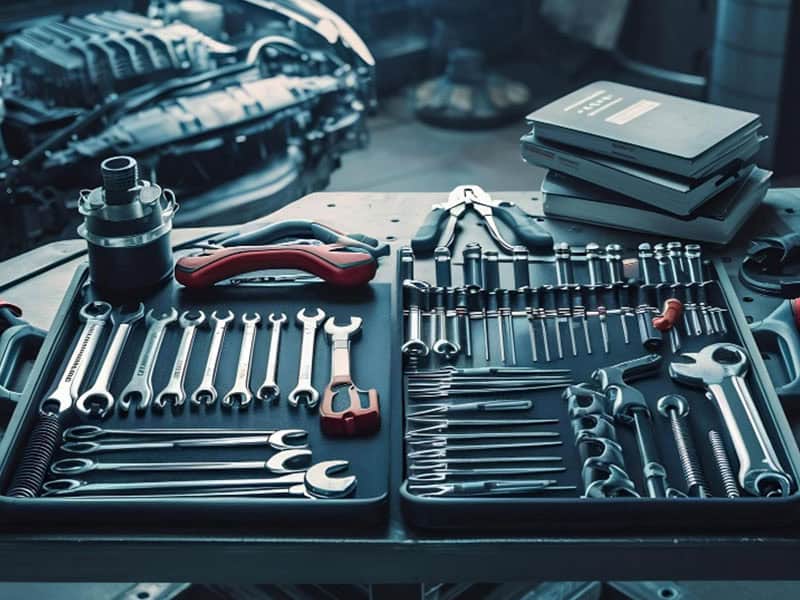
Running a highly profitable and efficient auto repair garage requires a strategic blend of heavy-duty hardware and smart digital solutions. The absolute essentials include core lifting equipment (Vehicle Lifts, Jacks), diagnostic technology (OBD-II Scanners), climate control machinery (AC Machines), and specialized mechanical tools. Crucially, binding these physical tools together requires robust Workshop Management Software and a comprehensive Garage Management system to handle workflow, inventory tracking, and customer communication seamlessly.
Whether you are opening a brand-new auto repair garage or upgrading an established service center, having the right equipment is non-negotiable. The modern automotive landscape is evolving rapidly. Worldwide—and particularly in the fast-paced, high-value Gulf region including the UAE, Saudi Arabia, and Qatar—mechanics are dealing with a mix of extreme driving conditions and a high density of modern, complex luxury vehicles.
In this competitive environment, a wrench and a good ear are no longer enough. Customers are searching for garages that are fully equipped, transparent, and capable of handling complex digital and mechanical diagnostics. To ensure your bay turnover rate remains high, your mechanics stay safe, and your business scales profitably, we have compiled the ultimate blueprint of the 16 essential tools every auto repair shop must have.
These are the foundational tools required for almost every major physical repair in your garage. Without these, heavy-duty repair is impossible.
1. Air Compressor
This is the heartbeat of your shop. An industrial-grade air compressor powers your pneumatic tools, from impact wrenches and air ratchets to auto lifts and paint sprayers. Without a reliable, high-capacity air compressor, your mechanics will face severe bottlenecks. Look for a two-stage rotary screw or heavy-duty piston compressor with a large enough tank (at least 60-100 gallons) and sufficient CFM (Cubic Feet per Minute) to supply continuous pressure to multiple bays simultaneously, ensuring no mechanic is left waiting for air pressure to build.
2. Jacks and Jack Stands
While lifts are ideal, you need durable floor jacks and heavy-duty jack stands to lift vehicles safely for quick inspections, tire rotations, or tight-space suspension work where a lift might be impractical. High-quality hydraulic aluminum or steel floor jacks with a low profile are essential, especially when servicing modern sports cars or sedans with incredibly low ground clearance. Safety is paramount here; never compromise on the weight rating of your jack stands.
3. Vehicle Lifts
Lifts are arguably the most critical investment for your service floor. Whether you choose a two-post lift for general repairs, brake jobs, and suspension work, or a four-post lift for wheel alignments and heavier commercial vehicles, lifts dictate the sheer volume of work you can handle. In the Gulf region, where heavy SUVs like Nissan Patrols, Mercedes G-Wagons, and Toyota Land Cruisers dominate the roads, investing in high-capacity (10,000 lbs to 15,000 lbs) asymmetrical lifts is an absolute must to handle the local market safely.
4. Free Standing Press
A robust free-standing hydraulic press capable of delivering over 30 tons of force is necessary for working with stubborn axle bearings, control arm bushings, and heavy-duty struts. Attempting to force these components without a dedicated press is not only highly dangerous to your mechanics but can easily bend or destroy expensive customer parts, eating directly into your profit margins.
5. Engine Hoist and Leveler
For major repairs where an engine or transmission must be physically removed from the chassis, a heavy-duty hydraulic engine hoist (often called a “cherry picker”) is mandatory. Paired with a precision load leveler, it allows your mechanics to safely and smoothly extract and install heavy power plants without damaging the vehicle’s firewall, radiator, or surrounding delicate engine bay components.
6. Oil Drain Pans and Caddies
Fluid changes are a daily, constant task, making upright, high-capacity oil drain caddies essential. Modern caddies come with pressurized evacuation systems, allowing mechanics to drain hot oil, transmission fluid, and coolant cleanly and rapidly. This keeps hazardous materials contained and prevents dangerous, slippery spills on your shop floor, maintaining a clean and professional environment.
7. Strut Compressor
Since suspension work is common for vehicles over 70,000 miles, a heavy-duty wall-mounted or freestanding strut compressor is required. Handling MacPherson struts is incredibly dangerous due to the immense stored kinetic energy in the heavy coil springs. Standard hand-held clamp compressors are too slow and risky for a high-volume shop. A professional-grade, stationary compressor ensures absolute safety and maximum speed for your technicians.
8. Air Conditioning Machine
Climate control service is a staple in auto repair, making a dedicated AC machine a highly necessary piece of equipment. This is critically important in the Gulf region, where extreme summer temperatures routinely exceed 45°C (113°F). In this market, a malfunctioning AC is not an inconvenience; it is an emergency. Modern AC machines automatically recover, vacuum, leak-test, recycle, and recharge both legacy R134a and the newer, environmentally friendly R1234yf refrigerants, ensuring you capture maximum high-ticket revenue during the long summer months.
9. Acetylene or Oxygen Torch
If you operate in an area where rust is common (or coastal areas with high salt and fine sand exposure like Dubai, Jeddah, or Doha), an oxy-acetylene torch is indispensable. Extreme, localized heat is often the only way to expand metal and loosen severely seized bolts, exhaust manifolds, and rusted suspension components without shearing the bolt heads off and creating hours of extra drilling and tapping work.
10. Steel Workbench
You need a solid, indestructible surface for tearing down components, rebuilding carburetors, inspecting delicate parts, or packing bearings. A heavy-gauge steel workbench equipped with a high-quality, securely mounted vise provides the necessary durability and stability to withstand the hammering, pressing, and heavy physical labor required in daily shop operations.
11. Jump Box and Battery Charger
Dead batteries and parasitic electrical draws are a daily occurrence. Commercial-grade portable jump boxes (preferably lithium-ion for lightweight portability) and rolling battery charger/tender units ensure you can move dead vehicles into the service bays quickly without tying up another vehicle to jump it. Modern smart chargers also feature diagnostic capabilities to test alternator ripple output and overall battery health, providing an opportunity for battery replacement sales.
12. Digital Vehicle Inspection (DVI) Software
Modern customers demand and appreciate transparency. DVI software allows your mechanics to use tablets to take photos and videos of worn parts and text them directly to the customer’s smartphone along with the inspection report. This strategy builds immediate trust, eliminates the “dishonest mechanic” stereotype, and has been proven across the industry to significantly increase average repair order (ARO) values. When a customer sees a video of their severely leaking water pump, they approve the repair.
13. Workshop Management Software
Your physical tools fix the cars, but your Workshop Management Software is what actually runs and scales your business. A comprehensive Garage Management system is the central nervous system of a modern, profitable shop.
- Automated Inventory Tracking: It automatically tracks and reorders fast-moving parts like oil filters, spark plugs, and brake pads.
- Invoicing & Estimates: Generates professional, branded quotes and invoices in seconds, complete with labor matrix calculations.
- Technician Productivity: Tracks billable hours versus actual hours to measure bay efficiency and mechanic profitability.
- Customer Retention: Sends automated SMS or email service reminders for upcoming oil changes, brake inspections, and annual registrations.
Particularly for garages operating worldwide or expanding across multiple locations in the Middle East, a cloud-based Garage Software allows owners to track Key Performance Indicators (KPIs), profitability, and customer satisfaction metrics from anywhere in the world in real-time.
14. Advanced Bidirectional OBD-II Diagnostic Scanner
You cannot repair what you cannot communicate with. A professional, bidirectional OBD-II diagnostic scanner (such as high-end models from Autel, Snap-on, or Launch) is absolutely mandatory. A basic code reader is not enough. You need a scanner that allows you to read deep manufacturer-specific fault codes, recalibrate steering angle sensors, program new key fobs, perform DPF regenerations, and actively command specific modules (like rolling down a window via the scanner to test the switch). This cuts diagnostic time from hours to mere minutes.
15. Heavy-Duty Transmission Jack
Removing a transmission or transfer case using a standard floor jack and a block of wood is dangerous, unstable, and highly inefficient. A specialized hydraulic transmission jack, featuring a wide, multi-axis adjustable cradle and heavy-duty safety chains, provides the exact stability required. It allows a single mechanic to safely lower, balance, and maneuver heavy automatic transmissions and transaxles, drastically improving safety and labor times.
16. On-Vehicle Brake Lathe Machine
Brake jobs are consistently one of the most highly profitable, high-frequency services an auto repair shop offers. Having an on-site brake lathe to precisely resurface brake rotors and drums keeps the entire job in-house. It saves the time and money of sending parts out to a local machine shop and provides a much faster turnaround for your customers. An on-vehicle lathe is particularly valuable as it machines the rotor directly on the hub, compensating for lateral runout and eliminating pedal pulsation issues entirely, boosting your reputation for quality brake work.
Equipment ROI & Usage Frequency Matrix
To help garage owners prioritize their capital investments, here is a strategic breakdown of tool frequency versus their average Return on Investment (ROI).
Equipment Category | Examples | Daily Usage Frequency | Profitability / ROI | Lifespan Expectancy |
Operational Software | Garage Management system, DVI | 100% (Used on every single transaction) | Very High (Saves hours of admin, prevents lost revenue) | Ongoing (Cloud-based updates) |
Heavy Lifting | Vehicle Lifts, Compressors, Jacks | 95% (Required for almost all mechanical repairs) | High (Enables the physical work to happen) | 10 – 15+ Years (With maintenance) |
Diagnostics | Bidirectional Scanners, Battery Testers | 80% (Used for check engine lights & modern servicing) | High (Allows for charging premium diagnostic fees) | 3 – 5 Years (Requires software updates) |
Climate Control | AC Recovery Machine | 60% (Highly Seasonal, but critical in the Gulf) | Very High (High ticket service, low labor time) | 7 – 10 Years |
Specialty Mechanical | Strut Compressor, Press, Lathe | 30% (Specific suspension or brake repairs) | Medium/High (Keeps specialized work in-house) | 15+ Years |
Data representation clearly highlights that while heavy lifts physically move the vehicles, a comprehensive Workshop Management Software touches 100% of your daily revenue, customer interactions, and overall operations.
FAQ'S
What is the most critical software for a modern auto repair shop?
The most critical software is a comprehensive Workshop Management Software, often referred to as a Garage Management system. It acts as the backbone of the business, handling everything from digital vehicle inspections, customer invoicing, and CRM, to parts inventory and employee time-tracking, streamlining your entire operation.
Why is investing in an AC Machine so critical for garages in the Gulf region?
In regions like the UAE, Saudi Arabia, and Qatar, summer temperatures frequently exceed 45°C. Air conditioning is considered a critical safety necessity, not just a comfort feature. Having a modern AC machine allows shops to perform fast, profitable, and environmentally compliant refrigerant recovery and recharges, capitalizing on the massive regional demand.
How do Digital Vehicle Inspections (DVI) increase garage revenue?
DVI increases revenue directly through visual transparency. When mechanics send customers high-resolution photos and videos of worn parts, customers are much more likely to approve the repair immediately. They can see the damage themselves, which builds trust and removes the traditional hesitation associated with mechanic up-sells.